
Join Our JEE Preparation Group
Prep with like-minded aspirants; Get access to free daily tests and study material.
Sign in
Please select an account to continue using cracku.in
↓ →
Join Our JEE Preparation Group
Prep with like-minded aspirants; Get access to free daily tests and study material.
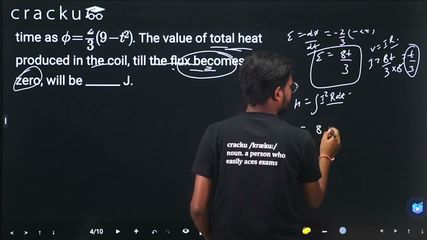
In a coil of resistance $$8 \Omega$$, the magnetic flux due to an external magnetic field varies with time as $$\phi = \dfrac{2}{3}(9 - t^2)$$. The value of total heat produced in the coil, till the flux becomes zero, will be ______ J.
Correct Answer: 2
Given the resistance of the coil $$R = 8 \, \Omega$$ and the magnetic flux $$\phi = \frac{2}{3}(9 - t^2)$$, we first determine the induced EMF.
Since the induced EMF is $$\text{EMF} = -\frac{d\phi}{dt} = -\frac{2}{3}(-2t) = \frac{4t}{3}$$, we next find the moment when the flux becomes zero.
When the magnetic flux vanishes, $$\frac{2}{3}(9 - t^2) = 0 \implies t^2 = 9 \implies t = 3 \text{ s}$$.
Substituting the expression for EMF into Ohm’s law yields the current in the coil as $$i = \frac{\text{EMF}}{R} = \frac{4t}{3 \times 8} = \frac{t}{6}$$.
Therefore, the total heat produced in the coil over the interval from 0 to 3 s is given by $$H = \int_0^3 i^2 R \, dt = \int_0^3 \left(\frac{t}{6}\right)^2 \times 8 \, dt$$. This reduces to $$= \int_0^3 \frac{t^2}{36} \times 8 \, dt = \frac{8}{36} \int_0^3 t^2 \, dt = \frac{2}{9} \left[\frac{t^3}{3}\right]_0^3 = \frac{2}{9} \times \frac{27}{3} = \frac{2}{9} \times 9 = 2 \text{ J}$$.
The total heat produced in the coil is $$\textbf{2}$$ J.
Was this solution helpful?
Click on the Email ☝️ to Watch the Video Solution
Create a FREE account and get:
_1.webp)

Educational materials for JEE preparation

Ask our AI anything

AI can make mistakes. Please verify important information.
AI can make mistakes. Please verify important information.
