
Join Our JEE Preparation Group
Prep with like-minded aspirants; Get access to free daily tests and study material.
Sign in
Please select an account to continue using cracku.in
↓ →
Join Our JEE Preparation Group
Prep with like-minded aspirants; Get access to free daily tests and study material.
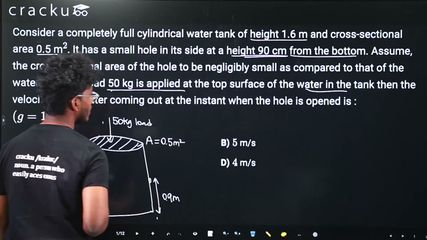
Consider a completely full cylindrical water tank of height 1.6 m and cross-sectional area 0.5 m$$^2$$. It has a small hole in its side at a height 90 cm from the bottom. Assume, the cross-sectional area of the hole to be negligibly small as compared to that of the water tank. If a load 50 kg is applied at the top surface of the water in the tank then the velocity of the water coming out at the instant when the hole is opened is : $$(g = 10\,\text{m/s}^2)$$
The tank is completely filled, so the vertical distance between the top free surface and the hole is the full column above the hole.
Depth of hole below the top surface:
$$h = 1.6\,\text{m} - 0.9\,\text{m} = 0.7\,\text{m}$$
1. Pressure at the hole due to the water column alone (hydrostatic law $$P = \rho g h$$):
Density of water $$\rho = 1000\,\text{kg/m}^3$$, acceleration due to gravity $$g = 10\,\text{m/s}^2$$.
$$P_{\text{water}} = \rho g h = 1000 \times 10 \times 0.7 = 7000\,\text{Pa}$$
2. Extra pressure caused by the 50 kg load placed on the water surface:
Area of the tank’s cross-section $$A = 0.5\,\text{m}^2$$.
Force of the load $$F = mg = 50 \times 10 = 500\,\text{N}$$.
Extra pressure $$P_{\text{load}} = \dfrac{F}{A} = \dfrac{500}{0.5} = 1000\,\text{Pa}$$
3. Total gauge pressure at the level of the hole:
$$P_{\text{total}} = P_{\text{water}} + P_{\text{load}} = 7000 + 1000 = 8000\,\text{Pa}$$
4. Speed of efflux (Torricelli’s theorem with an added surface pressure):
For a small orifice the velocity is obtained from energy balance
$$v = \sqrt{\dfrac{2 P_{\text{total}}}{\rho}}$$
Substituting values:
$$v = \sqrt{\dfrac{2 \times 8000}{1000}} = \sqrt{16} = 4\,\text{m/s}$$
Therefore, the velocity of water emerging from the hole is 4 m/s.
Option D.
Was this solution helpful?
Click on the Email ☝️ to Watch the Video Solution
Create a FREE account and get:
_1.webp)

Educational materials for JEE preparation

Ask our AI anything

AI can make mistakes. Please verify important information.
AI can make mistakes. Please verify important information.


