
Join Our JEE Preparation Group
Prep with like-minded aspirants; Get access to free daily tests and study material.
Sign in
Please select an account to continue using cracku.in
↓ →
Join Our JEE Preparation Group
Prep with like-minded aspirants; Get access to free daily tests and study material.
Melting takes place isothermally at $$T = 273\;\text{K}$$ and constant atmospheric pressure $$P = 1\;\text{atm}$$ (≈ $$1.013\times10^{5}\;\text{Pa}$$).
At constant pressure the heat absorbed equals the molar enthalpy of fusion:
$$q_{p}= \Delta H_{fus} \;\;(\text{positive})$$
The first-law relation connecting enthalpy and internal energy is
$$\Delta H = \Delta U + P\,\Delta V \quad -(1)$$
Rearranging, the change in internal energy is
$$\Delta U = \Delta H - P\,\Delta V \quad -(2)$$
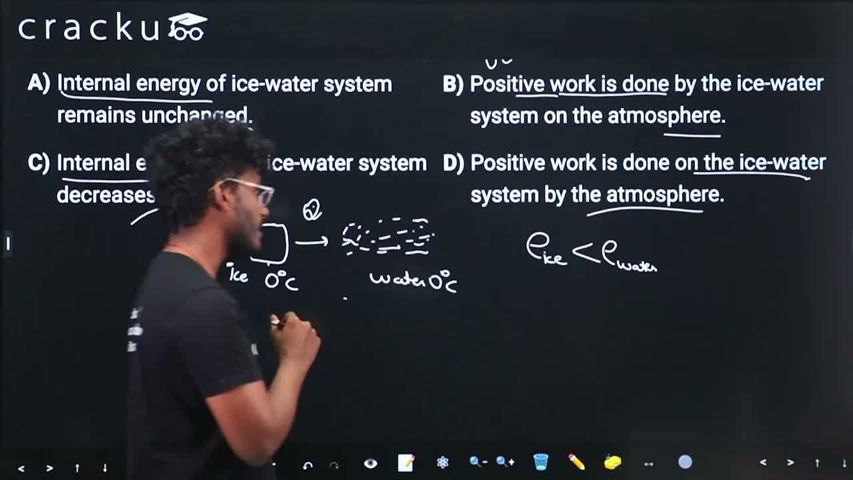
When ice converts to water its volume decreases because water is denser than ice:
density of ice ≈ $$0.917\;\text{g cm}^{-3}$$, density of water ≈ $$1.00\;\text{g cm}^{-3}$$.
Hence $$\Delta V \lt 0$$ (final volume < initial volume).
Work done by the system on the atmosphere is
$$w = P\,\Delta V$$.
Since $$\Delta V \lt 0$$, $$w$$ is negative: the system does negative work, that is, the atmosphere does positive work on the system.
Substituting $$\Delta V \lt 0$$ in $$(2)$$:
$$\Delta U = \Delta H - P\,(\text{negative}) = \Delta H + (\text{positive term})$$.
Therefore $$\Delta U \gt 0$$; the internal energy increases, it certainly does not remain unchanged or decrease.
Summarising:
• Internal energy increases ⇒ Options A and C are incorrect.
• Work done on the system is positive ⇒ Option B is incorrect, Option D is correct.
Hence the correct choice is Option D: Positive work is done on the ice-water system by the atmosphere.
Was this solution helpful?
Click on the Email ☝️ to Watch the Video Solution
Create a FREE account and get:
_1.webp)

Educational materials for JEE preparation

Ask our AI anything

AI can make mistakes. Please verify important information.
AI can make mistakes. Please verify important information.


