
Join Our JEE Preparation Group
Prep with like-minded aspirants; Get access to free daily tests and study material.
Sign in
Please select an account to continue using cracku.in
↓ →
Join Our JEE Preparation Group
Prep with like-minded aspirants; Get access to free daily tests and study material.
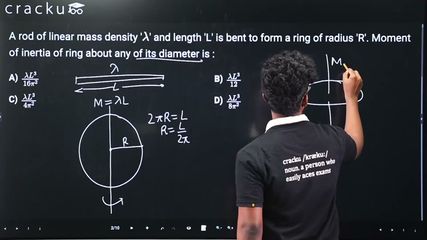
A rod of linear mass density '$$\lambda$$' and length 'L' is bent to form a ring of radius 'R'. Moment of inertia of ring about any of its diameter is :
The straight rod is bent until its two ends meet, so the whole length of the rod becomes the circumference of a circle.
Hence, $$\text{circumference}=2\pi R=L$$ $$-(1)$$ which gives $$R=\frac{L}{2\pi}$$ $$-(2)$$
Mass of the ring: linear mass density $$\lambda$$ means $$m=\lambda\times(\text{length})=\lambda L$$ $$-(3)$$
For a thin ring of mass $$m$$ and radius $$R$$:
• Moment of inertia about the axis perpendicular to its plane and passing through the centre is $$I_{z}=mR^{2}$$. • For any diameter (say $$x$$-axis) lying in the plane of the ring, use the perpendicular-axis theorem: $$I_{x}+I_{y}=I_{z}$$. Because of symmetry, $$I_{x}=I_{y}=I_{d}$$ (moment of inertia about any diameter), so
$$2I_{d}=mR^{2} \;\; \Longrightarrow \;\; I_{d}=\frac{mR^{2}}{2}$$ $$-(4)$$
Substitute $$m$$ from $$(3)$$ and $$R$$ from $$(2)$$ into $$(4)$$:
$$I_{d}=\frac{\lambda L}{2}\left(\frac{L}{2\pi}\right)^{2} =\frac{\lambda L}{2}\cdot\frac{L^{2}}{4\pi^{2}} =\frac{\lambda L^{3}}{8\pi^{2}}$$
Thus, the moment of inertia of the ring about any diameter is $$\boxed{\displaystyle \frac{\lambda L^{3}}{8\pi^{2}}}$$, which corresponds to Option D.
Was this solution helpful?
Click on the Email ☝️ to Watch the Video Solution
Create a FREE account and get:
_1.webp)

Educational materials for JEE preparation

Ask our AI anything

AI can make mistakes. Please verify important information.
AI can make mistakes. Please verify important information.
