
Join Our JEE Preparation Group
Prep with like-minded aspirants; Get access to free daily tests and study material.
Sign in
Please select an account to continue using cracku.in
↓ →
Join Our JEE Preparation Group
Prep with like-minded aspirants; Get access to free daily tests and study material.
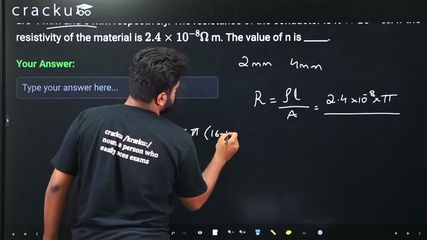
A hollow cylindrical conductor has length of 3.14 m, while its inner and outer diameters are 4 mm and 8 mm respectively. The resistance of the conductor is $$n \times 10^{-3} \Omega$$. If the resistivity of the material is $$2.4 \times 10^{-8} \Omega$$ m. The value of n is _____.
Correct Answer: 2
The resistance of a uniform conductor is given by the formula $$R=\dfrac{\rho\,L}{A}$$, where $$\rho$$ is the resistivity, $$L$$ is the length and $$A$$ is the cross-sectional area perpendicular to the current.
For a hollow cylindrical conductor, the current flows through the annular (ring-shaped) cross-section.
Outer diameter $$=8\text{ mm}=8\times10^{-3}\text{ m}$$, so outer radius $$R_o=4\times10^{-3}\text{ m}$$.
Inner diameter $$=4\text{ mm}=4\times10^{-3}\text{ m}$$, so inner radius $$R_i=2\times10^{-3}\text{ m}$$.
Area of an annulus:
$$A=\pi\!\left(R_o^{\,2}-R_i^{\,2}\right)$$
Substituting the radii:
$$A=\pi\!\left[(4\times10^{-3})^{2}-(2\times10^{-3})^{2}\right]$$
$$=\pi\!\left(16\times10^{-6}-4\times10^{-6}\right)$$
$$=\pi\,(12\times10^{-6})$$
$$=12\pi\times10^{-6}\ \text{m}^2$$
Given length $$L=3.14\ \text{m}$$ and resistivity $$\rho=2.4\times10^{-8}\ \Omega\!\,\text{m}$$, the resistance is
$$R=\dfrac{\rho\,L}{A} =\dfrac{(2.4\times10^{-8})(3.14)}{12\pi\times10^{-6}}$$
Because $$\pi\approx3.14$$, the factor $$3.14/\pi$$ is approximately $$1$$, so
$$R\approx\dfrac{2.4\times10^{-8}}{12\times10^{-6}} =\dfrac{2.4}{12}\times10^{-2} =0.2\times10^{-2} =2\times10^{-3}\ \Omega$$
Thus $$R = n\times10^{-3}\ \Omega$$ with $$n=2$$.
Answer : $$n = 2$$
Was this solution helpful?
Click on the Email ☝️ to Watch the Video Solution
Create a FREE account and get:
_1.webp)

Educational materials for JEE preparation

Ask our AI anything

AI can make mistakes. Please verify important information.
AI can make mistakes. Please verify important information.
