
Join Our JEE Preparation Group
Prep with like-minded aspirants; Get access to free daily tests and study material.
Sign in
Please select an account to continue using cracku.in
↓ →
Join Our JEE Preparation Group
Prep with like-minded aspirants; Get access to free daily tests and study material.
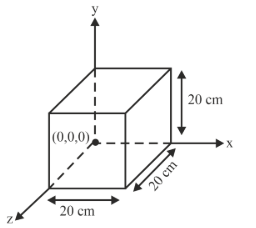
Expression for an electric field is given by $$\vec{E} = 4000 \; x^2 \; \hat{i}$$ V m$$^{-1}$$. The electric flux through the cube of side 20 cm when placed in electric field (as shown in the figure) is ______ V cm.
Correct Answer: 640
The electric field is uniform in direction (along $$+\hat{i}$$) but varies with the $$x$$-coordinate:
$$\vec E = 4000\,x^{2}\,\hat{i}\;{\text{V m}}^{-1}$$.
Place the cube so that its faces are perpendicular to the coordinate axes and the two faces perpendicular to the $$x$$-axis lie at $$x = 0$$ and $$x = a$$, where the edge length of the cube is
$$a = 20 \text{ cm} = 0.20 \text{ m}$$.
Electric flux through a closed surface is
$$\Phi = \oint_S \vec E \cdot d\vec A$$.
The field has no $$y$$ or $$z$$ components, so the four faces whose outward normals are $$\pm\hat{j}$$ or $$\pm\hat{k}$$ give zero contribution because $$\vec E \cdot d\vec A = 0$$ there.
Only the two faces perpendicular to the $$x$$-axis contribute.
Case 1: Face at $$x = a = 0.20\text{ m}$$ (right face)Outward normal $$\hat n = +\hat{i}$$,
$$d\vec A = \hat{i}\,dA$$,
$$\vec E \cdot d\vec A = E_x\,dA = (4000\,a^{2})\,dA$$.
Total flux through this face:
$$\Phi_{x=a} = E_x(a)\,A = 4000\,a^{2}\,A$$, where $$A = a^{2}$$ is the area of one face.
Outward normal $$\hat n = -\hat{i}$$,
$$d\vec A = -\hat{i}\,dA$$,
$$\vec E \cdot d\vec A = -E_x(0)\,dA = 0$$ because $$E_x(0)=0$$.
Hence $$\Phi_{x=0} = 0$$.
Net outward flux through the entire cube:
$$\Phi = \Phi_{x=a} - \Phi_{x=0} = 4000\,a^{2}\,A$$.
Substitute $$a = 0.20 \text{ m}$$:
$$A = a^{2} = (0.20)^{2} = 0.040 \text{ m}^{2}$$,
$$E_x(a) = 4000\,(0.20)^{2} = 4000 \times 0.040 = 160 \text{ V m}^{-1}$$.
Therefore
$$\Phi = 160 \text{ V m}^{-1} \times 0.040 \text{ m}^{2} = 6.4 \text{ V m}.$$
The question asks for the answer in $$\text{V cm}$$. Since $$1 \text{ m} = 100 \text{ cm}$$,
$$6.4 \text{ V m} = 6.4 \times 100 \text{ V cm} = 640 \text{ V cm}.$$
Electric flux through the cube = 640 V cm.
Was this solution helpful?
Create a FREE account and get:
_1.webp)

Educational materials for JEE preparation

Ask our AI anything

AI can make mistakes. Please verify important information.
AI can make mistakes. Please verify important information.
