
Join Our JEE Preparation Group
Prep with like-minded aspirants; Get access to free daily tests and study material.
Sign in
Please select an account to continue using cracku.in
↓ →
Join Our JEE Preparation Group
Prep with like-minded aspirants; Get access to free daily tests and study material.
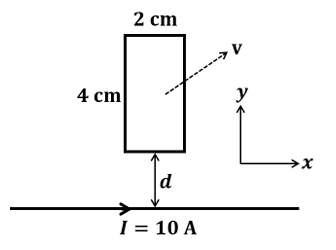
A rectangular conducting loop of length 4 cm and width 2 cm is in the $$xy$$-plane, as shown in the figure. It is being moved away from a thin and long conducting wire along the direction $$\frac{\sqrt{3}}{2}\hat{x} + \frac{1}{2}\hat{y}$$ with a constant speed $$v$$. The wire is carrying a steady current I = 10 A in the positive $$x$$-direction. A current of 10 $$\mu$$A flows through the loop when it is at a distance $$d = 4$$ cm from the wire. If the resistance of the loop is 0.1 $$\Omega$$, then the value of $$v$$ is ____ ms$$^{-1}$$.
[Given: The permeability of free space $$\mu_0 = 4\pi \times 10^{-7}$$ NA$$^{-2}$$]
Correct Answer: 4
Let the long straight wire coincide with the $$x$$-axis and carry a steady current $$I = 10 \, \text{A}$$ in the $$+\hat{x}$$-direction.
Hence the magnetic field produced by the wire at a point at distance $$r$$ from the wire (in the $$y$$-direction) is
$$B = \frac{\mu_0 I}{2\pi r}$$
and it is perpendicular to the $$xy$$-plane (along $$\pm \hat{z}$$).
Therefore the magnetic flux through a rectangular loop lying in the $$xy$$-plane depends only on its distance from the wire.
The rectangle has
length (side along $$y$$) : $$l = 4 \, \text{cm} = 0.04 \, \text{m}$$
width (side parallel to the wire, along $$x$$) : $$w = 2 \, \text{cm} = 0.02 \, \text{m}$$.
When the nearer edge of the loop is at a distance $$d = 4 \, \text{cm} = 0.04 \, \text{m}$$ from the wire, the farther edge is at $$d + l = 0.04 + 0.04 = 0.08 \, \text{m}$$.
The magnetic flux through the loop is
$$\Phi = \int_{x = 0}^{w} \int_{y = d}^{d+l} B(y)\, dy \, dx = w \frac{\mu_0 I}{2\pi}\int_{d}^{d+l}\frac{dy}{y} = w \frac{\mu_0 I}{2\pi}\ln\!\left(\frac{d+l}{d}\right).$$
The loop is pulled away from the wire with constant velocity
$$\vec{v}=v\left(\frac{\sqrt{3}}{2}\hat{x}+\frac{1}{2}\hat{y}\right).$$
Only the $$y$$-component changes the distance $$d$$, so
$$\frac{dd}{dt}=v_y=\frac{v}{2}.$$
Induced emf (magnitude) is
$$\mathcal{E}= \left|\frac{d\Phi}{dt}\right| = w\frac{\mu_0 I}{2\pi}\left|\frac{-l}{d(d+l)}\right|\frac{dd}{dt} = w\frac{\mu_0 I l}{2\pi d(d+l)}\frac{v}{2}.$$
Using Ohm’s law, $$\mathcal{E}=IR_{\text{loop}}$$, where
induced current $$I_{\text{loop}} = 10\,\mu\text{A}=1.0\times10^{-5}\,\text{A}$$ and
resistance $$R_{\text{loop}} = 0.1\,\Omega$$.
Hence
$$\mathcal{E}=I_{\text{loop}}R_{\text{loop}}
=(1.0\times10^{-5})(0.1)
=1.0\times10^{-6}\,\text{V}.$$
Equating the two expressions for $$\mathcal{E}$$:
$$1.0\times10^{-6} = w\frac{\mu_0 I l}{2\pi d(d+l)}\frac{v}{2}.$$
Insert the numerical values:
$$w = 0.02,\; l = 0.04,\; d = 0.04,\; I = 10,\;
\mu_0 = 4\pi\times10^{-7}.$$
$$1.0\times10^{-6} = 0.02\frac{(4\pi\times10^{-7})(10)(0.04)}{2\pi(0.04)(0.08)}\frac{v}{2}.$$
Simplify:
$$1.0\times10^{-6} = 0.02\frac{(4\times10^{-7})(10)(0.04)}{2(0.04)(0.08)}\frac{v}{2}$$
$$1.0\times10^{-6} = \frac{0.02\times4\times10^{-7}\times10\times0.04}{2\times0.04\times0.08}\,\frac{v}{2}$$
Evaluate the constant factor:
Numerator $$=0.02\times4\times10^{-7}\times10\times0.04=3.2\times10^{-9}$$
Denominator $$=2\times0.04\times0.08=6.4\times10^{-3}$$
Thus
$$1.0\times10^{-6}
=\left(\frac{3.2\times10^{-9}}{6.4\times10^{-3}}\right)\frac{v}{2}
=5.0\times10^{-7}\,\frac{v}{2}.$$
Hence $$1.0\times10^{-6}=2.5\times10^{-7}v$$
so $$v = \frac{1.0\times10^{-6}}{2.5\times10^{-7}} = 4 \, \text{m\,s}^{-1}.$$
Therefore, the speed of the loop is
4 m s−1.
Was this solution helpful?
Create a FREE account and get:
_1.webp)

Educational materials for JEE preparation

Ask our AI anything

AI can make mistakes. Please verify important information.
AI can make mistakes. Please verify important information.
