
Join Our JEE Preparation Group
Prep with like-minded aspirants; Get access to free daily tests and study material.
Sign in
Please select an account to continue using cracku.in
↓ →
Join Our JEE Preparation Group
Prep with like-minded aspirants; Get access to free daily tests and study material.
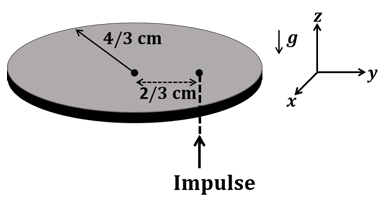
A thin circular coin of mass 5 gm and radius 4/3 cm is initially in a horizontal $$xy$$-plane. The coin is tossed vertically up (+z direction) by applying an impulse of $$\sqrt{\frac{\pi}{2}} \times 10^{-2}$$ N-s at a distance 2/3 cm from its center. The coin spins about its diameter and moves along the +z direction. By the time the coin reaches back to its initial position, it completes $$n$$ rotations. The value of $$n$$ is ____.
[Given: The acceleration due to gravity $$g = 10$$ ms$$^{-2}$$]
Correct Answer: 30
The coin is a thin uniform disc of mass $$m = 5\text{ g}=0.005\text{ kg}$$ and radius $$R=\frac{4}{3}\text{ cm}=0.013333\text{ m}$$ that lies in the horizontal $$xy$$-plane.
An impulse of magnitude $$J=\sqrt{\frac{\pi}{2}}\times10^{-2}\ \text{N·s}$$ is applied vertically upward (along +$$z$$) at a point whose distance from the centre is $$r=\frac{2}{3}\text{ cm}=0.006667\text{ m}$$. Because the line of action does not pass through the centre, the impulse produces:
• a translational momentum $$J$$ along +$$z$$,
• an angular momentum (about the centre) whose magnitude is $$L = rJ$$, perpendicular to both $$\vec r$$ and $$\vec J$$, i.e. about a diameter of the disc.
Step 1: Translational upward velocity
Impulse-momentum theorem: $$J = m v_{\text{cm}} \ \Rightarrow\ v_{\text{cm}} = \frac{J}{m}$$
Compute $$J$$ first:
$$J = \sqrt{\frac{\pi}{2}}\times10^{-2} = 1.2523\times10^{-2}\ \text{N·s}$$
Hence
$$v_{\text{cm}} = \frac{1.2523\times10^{-2}}{0.005}=2.5046\ \text{m s}^{-1}$$
Step 2: Time of flight
The coin is projected upward with speed $$v_{\text{cm}}$$ and returns to its initial level under gravity.
Time of flight:
$$T = \frac{2v_{\text{cm}}}{g} = \frac{2(2.5046)}{10}=0.5009\ \text{s}$$
Step 3: Angular speed imparted about a diameter
Magnitude of angular momentum:
$$L = rJ = (0.006667)(1.2523\times10^{-2}) = 8.3487\times10^{-5}\ \text{kg m}^2\text{ s}^{-1}$$
Moment of inertia of a thin disc about a diameter:
$$I = \frac{1}{4}mR^{2}$$
$$R^{2} = (0.013333)^{2}=1.7778\times10^{-4}\ \text{m}^{2}$$
$$I = \frac{1}{4}(0.005)(1.7778\times10^{-4}) = 2.2222\times10^{-7}\ \text{kg m}^{2}$$
Angular speed:
$$\omega = \frac{L}{I} = \frac{8.3487\times10^{-5}}{2.2222\times10^{-7}}
= 3.7569\times10^{2}\ \text{rad s}^{-1}$$
Step 4: Number of complete rotations during the flight
$$n=\frac{\omega T}{2\pi}=
\frac{(3.7569\times10^{2})(0.5009)}{2\pi}
=\frac{1.8803\times10^{2}}{6.2832}=29.9\approx30$$
Hence, by the time the coin returns to its initial position, it completes about 30 rotations.
Answer: 30
Was this solution helpful?
Create a FREE account and get:
_1.webp)

Educational materials for JEE preparation

Ask our AI anything

AI can make mistakes. Please verify important information.
AI can make mistakes. Please verify important information.
