
Join Our JEE Preparation Group
Prep with like-minded aspirants; Get access to free daily tests and study material.
Sign in
Please select an account to continue using cracku.in
↓ →
Join Our JEE Preparation Group
Prep with like-minded aspirants; Get access to free daily tests and study material.
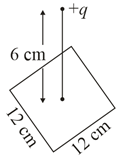
A point charge of $$+12$$ $$\mu C$$ is at a distance 6 cm vertically above the centre of a square of side 12 cm as shown in figure. The magnitude of the electric flux through the square will be ______ $$\times 10^3$$ N m$$^2$$ C$$^{-1}$$.
Correct Answer: 226
A point charge of $$q = +12 \; \mu\text{C} = 12 \times 10^{-6}$$ C is placed 6 cm vertically above the centre of a square of side 12 cm. To find the electric flux through the square, we use the concept of a Gaussian surface in the form of a cube.
Consider a cube of side 12 cm with the given square as one of its faces. If we place this cube such that the charge is at its centre, the charge would need to be at a height of 6 cm above the square, which is exactly half the side length of the cube. Therefore, the charge is located precisely at the centre of the cube.
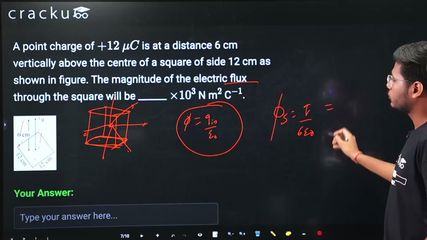
By Gauss's law, the total electric flux through the entire closed cube is $$\Phi_{\text{total}} = \frac{q}{\varepsilon_0}$$. By symmetry, this flux is equally distributed through all 6 faces of the cube. Therefore, the flux through one face (our square) is $$\Phi = \frac{q}{6\varepsilon_0}$$.
Substituting the values: $$\Phi = \frac{12 \times 10^{-6}}{6 \times 8.854 \times 10^{-12}} = \frac{2 \times 10^{-6}}{8.854 \times 10^{-12}} = 2.259 \times 10^{5}$$ N m$$^2$$ C$$^{-1}$$.
Expressing this as $$x \times 10^3$$ N m$$^2$$ C$$^{-1}$$: $$\Phi = 225.9 \times 10^3 \approx 226 \times 10^3$$ N m$$^2$$ C$$^{-1}$$.
Therefore, the magnitude of the electric flux through the square is $$226 \times 10^3$$ N m$$^2$$ C$$^{-1}$$.
Was this solution helpful?
Click on the Email ☝️ to Watch the Video Solution
Create a FREE account and get:
_1.webp)

Educational materials for JEE preparation

Ask our AI anything

AI can make mistakes. Please verify important information.
AI can make mistakes. Please verify important information.


