
Join Our JEE Preparation Group
Prep with like-minded aspirants; Get access to free daily tests and study material.
Sign in
Please select an account to continue using cracku.in
↓ →
Join Our JEE Preparation Group
Prep with like-minded aspirants; Get access to free daily tests and study material.
The number of points in the interval $$[2, 4]$$, at which the function $$f(x) = \left\lfloor x^2 - x - \frac{1}{2} \right\rfloor$$, where $$[\cdot]$$ denotes the greatest integer function, is discontinuous, is _________.
Correct Answer: 10
For a function of the form $$f(x)=\lfloor g(x)\rfloor$$ the only points of discontinuity occur when $$g(x)$$ itself is an integer. This is because the greatest-integer (floor) function makes a jump of size $$1$$ whenever its argument crosses an integral value.
Here $$g(x)=x^{2}-x-\dfrac12$$. We must therefore solve
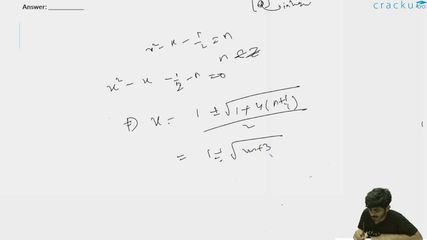
$$x^{2}-x-\dfrac12=n,$$ where $$n\in\mathbb{Z}$$. Rearranging,
$$x^{2}-x-\left(n+\dfrac12\right)=0$$ is a quadratic with roots
$$x=\dfrac{1\pm\sqrt{1+4\left(n+\dfrac12\right)}}{2} =\dfrac{1\pm\sqrt{4n+3}}{2}.$$
We want those roots that lie inside the given interval $$[2,4]$$.
Case + : $$x=\dfrac{1+\sqrt{4n+3}}{2}$$
Impose $$2\le x\le4$$:
$$2\le\dfrac{1+\sqrt{4n+3}}{2}\le4 \;\Longrightarrow\; 4\le1+\sqrt{4n+3}\le8$$
Subtract $$1$$ and square-root inequality signs stay the same (all quantities are non-negative):
$$3\le\sqrt{4n+3}\le7 \;\Longrightarrow\; 9\le4n+3\le49$$
$$\Longrightarrow\;6\le4n\le46 \;\Longrightarrow\;1.5\le n\le11.5.$$
Since $$n$$ is an integer,
$$n=2,3,4,5,6,7,8,9,10,11\quad\text{(total 10 values).}$$
Case − : $$x=\dfrac{1-\sqrt{4n+3}}{2}$$
Because $$\sqrt{4n+3}\gt0,$$ the numerator $$1-\sqrt{4n+3}\le1$$, hence
$$x\le\dfrac12\lt2,$$
so no root from the “minus” branch can lie inside $$[2,4]$$.
Therefore exactly one $$x$$ in $$[2,4]$$ corresponds to each of the ten integers $$n=2$$ through $$11$$, giving 10 discontinuity points in the required interval.
Hence, the number of points of discontinuity of $$f(x)$$ in $$[2,4]$$ is $$\mathbf{10}$$.
Was this solution helpful?
Click on the Email ☝️ to Watch the Video Solution
Create a FREE account and get:
_1.webp)

Educational materials for JEE preparation

Ask our AI anything

AI can make mistakes. Please verify important information.
AI can make mistakes. Please verify important information.
