
Join Our JEE Preparation Group
Prep with like-minded aspirants; Get access to free daily tests and study material.
Sign in
Please select an account to continue using cracku.in
↓ →
Join Our JEE Preparation Group
Prep with like-minded aspirants; Get access to free daily tests and study material.
Let $$H_1:\frac{x^2}{a^2}-\frac{y^2}{b^2}=1$$ and $$H_2:-\frac{x^2}{A^2}+\frac{y^2}{B^2}=1$$ be two hyperbolas having length of latus rectums $$15\sqrt{2}$$ and $$12\sqrt{5}$$ respectively. Let their eccentricities be $$e_1=\sqrt{\frac{5}{2}}$$ and $$e_2$$ respectively. If the product of the lengths of their transverse axes is $$100\sqrt{10},$$ then $$25e_2^2$$ is equal to $$\underline{\hspace{2cm}}.$$
Correct Answer: 55
We are given two hyperbolas $$H_1: \frac{x^2}{a^2} - \frac{y^2}{b^2} = 1$$ and $$H_2: -\frac{x^2}{A^2} + \frac{y^2}{B^2} = 1$$ with the latus rectum of $$H_1$$ equal to $$15\sqrt{2}$$, the latus rectum of $$H_2$$ equal to $$12\sqrt{5}$$, the eccentricity $$e_1 = \sqrt{\frac{5}{2}}$$, and the product of their transverse axes equal to $$100\sqrt{10}$$. Our goal is to find $$25e_2^2$$.
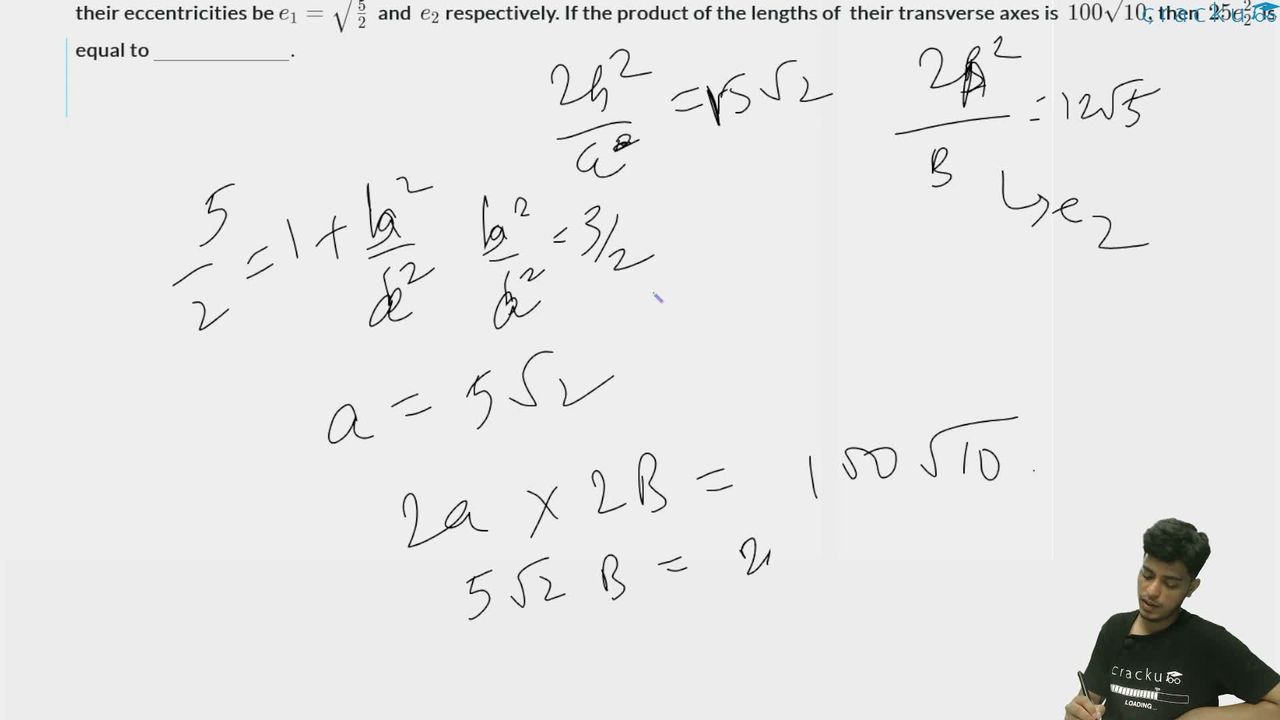
For the first hyperbola, the transverse axis is $$2a$$, the latus rectum is $$\frac{2b^2}{a}$$, and we have $$b^2 = a^2(e_1^2 - 1)$$. For the second hyperbola (in its conjugate form), the transverse axis is $$2B$$, the latus rectum is $$\frac{2A^2}{B}$$, and $$A^2 = B^2(e_2^2 - 1)$$.
Since $$e_1 = \sqrt{\frac{5}{2}}$$, it follows that $$e_1^2 = \frac{5}{2}$$ and hence $$b^2 = a^2\left(\frac{5}{2} - 1\right) = \frac{3a^2}{2}$$. Substituting into the expression for the latus rectum of $$H_1$$ gives $$\frac{2b^2}{a} = \frac{2\cdot\frac{3a^2}{2}}{a} = 3a = 15\sqrt{2}$$, which yields $$a = 5\sqrt{2}$$.
Therefore the transverse axis of $$H_1$$ is $$2a = 10\sqrt{2}$$. Since the product of the transverse axes is $$(2a)(2B) = 100\sqrt{10}$$, we have $$10\sqrt{2}\cdot 2B = 100\sqrt{10}$$. This gives $$2B = \frac{100\sqrt{10}}{10\sqrt{2}} = 10\sqrt{5}$$ and hence $$B = 5\sqrt{5}$$.
Turning to the second hyperbola, its latus rectum satisfies $$\frac{2A^2}{B} = 12\sqrt{5}$$, so $$A^2 = \frac{12\sqrt{5}\cdot B}{2} = \frac{12\sqrt{5}\cdot 5\sqrt{5}}{2} = \frac{300}{2} = 150$$.
Using the relation $$A^2 = B^2(e_2^2 - 1)$$ gives $$150 = 125(e_2^2 - 1)$$, so $$e_2^2 - 1 = \frac{150}{125} = \frac{6}{5}$$ and therefore $$e_2^2 = 1 + \frac{6}{5} = \frac{11}{5}$$.
Finally, we compute $$25e_2^2 = 25 \times \frac{11}{5} = 55$$.
The answer is 55
Was this solution helpful?
Click on the Email ☝️ to Watch the Video Solution
Create a FREE account and get:
_1.webp)

Educational materials for JEE preparation

Ask our AI anything

AI can make mistakes. Please verify important information.
AI can make mistakes. Please verify important information.
