
Join Our JEE Preparation Group
Prep with like-minded aspirants; Get access to free daily tests and study material.
Sign in
Please select an account to continue using cracku.in
↓ →
Join Our JEE Preparation Group
Prep with like-minded aspirants; Get access to free daily tests and study material.
The number of singular matrices of order 2, whose elements are from the set $$\{2, 3, 6, 9\}$$ is
Correct Answer: 36
Let the matrix be $$\begin{pmatrix}a & b \\ c & d\end{pmatrix}$$ where each entry comes from the set $$S=\{2,3,6,9\}$$.
A $$2\times2$$ matrix is singular when its determinant is zero, i.e. when
$$\det\begin{pmatrix}a & b \\ c & d\end{pmatrix}=ad-bc=0 \; \Longleftrightarrow \; ad=bc.$$
Thus we must count the ordered quadruples $$(a,b,c,d)\in S^{4}$$ satisfying $$ad=bc.$$
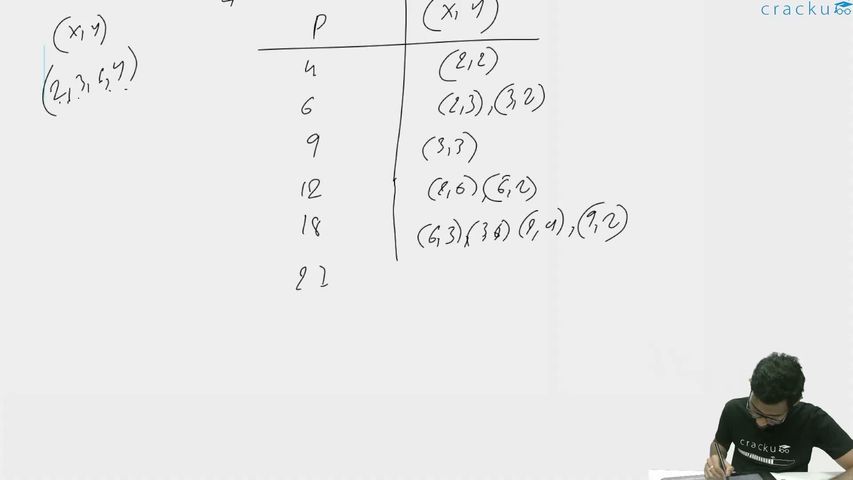
Step 1 - List every possible ordered pair from $$S$$ together with its product $$p=xy$$.
Because order matters, $$(x,y)$$ and $$(y,x)$$ are counted separately.
$$\begin{array}{c|c} (x,y) & p=xy \\ \hline (2,2) & 4 \\ (2,3),\,(3,2) & 6 \\ (3,3) & 9 \\ (2,6),\,(6,2) & 12 \\ (2,9),\,(3,6),\,(6,3),\,(9,2) & 18 \\ (3,9),\,(9,3) & 27 \\ (6,6) & 36 \\ (6,9),\,(9,6) & 54 \\ (9,9) & 81 \end{array}$$
Denote by $$n_p$$ the number of ordered pairs $$(x,y)$$ whose product equals $$p$$.
From the table we obtain
$$n_4=1,\; n_6=2,\; n_9=1,\; n_{12}=2,\; n_{18}=4,\; n_{27}=2,\; n_{36}=1,\; n_{54}=2,\; n_{81}=1.$$
Step 2 - Form the matrix.
For a fixed product $$p$$, we can pick $$(a,d)$$ in $$n_p$$ ways and independently pick $$(b,c)$$ in another $$n_p$$ ways, giving $$n_p^2$$ matrices with determinant zero corresponding to that product.
Step 3 - Add over all possible products:
$$\text{Number of singular matrices}= \sum_{p} n_p^{2}$$ $$=1^{2}+2^{2}+1^{2}+2^{2}+4^{2}+2^{2}+1^{2}+2^{2}+1^{2}$$ $$=1+4+1+4+16+4+1+4+1$$ $$=36.$$
Hence, the total number of singular $$2\times2$$ matrices whose elements are chosen from $$\{2,3,6,9\}$$ is $$36$$.
Was this solution helpful?
Click on the Email ☝️ to Watch the Video Solution
Create a FREE account and get:
_1.webp)

Educational materials for JEE preparation

Ask our AI anything

AI can make mistakes. Please verify important information.
AI can make mistakes. Please verify important information.
