
Join Our JEE Preparation Group
Prep with like-minded aspirants; Get access to free daily tests and study material.
Sign in
Please select an account to continue using cracku.in
↓ →
Join Our JEE Preparation Group
Prep with like-minded aspirants; Get access to free daily tests and study material.
In figure, the optical fiber is $$l = 2$$ m long and has a diameter of $$d = 20 \; \mu$$m. If a ray of light is incident on one end of the fiber at angle $$\theta_1 = 40°$$, the number of reflections it makes before emerging from the other end is close to: (refractive index of fiber is 1.31, sin 40° = 0.64 and sin$$^{-1}$$(0.49) = 30°.)
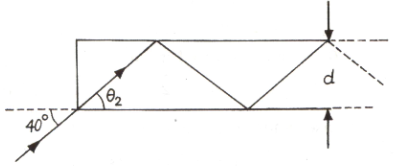
Using Snell’s law at the entrance of the optical fiber,
$$1\times \sin40^\circ=(1.31)\sin\theta_2$$
Given,
$$\sin40^\circ=0.64$$
So,
$$\sin\theta_2=\frac{0.64}{1.31}$$
$$\sin\theta_2\approx0.49$$
$$\theta_2=\sin^{-1}(0.49)\approx30^\circ$$
Inside the fiber,
$$\tan\theta_2=\frac{d}{x}$$
where
$$d=20\ \mu m=20\times10^{-6}\ m$$
x = distance between two successive reflections
Using,
$$\tan30^\circ=\frac{1}{\sqrt3}$$
$$\frac{1}{\sqrt3}=\frac{d}{x}$$
$$x=\sqrt3 d$$
Number of reflections:
$$N=\frac{\ell}{x}$$
Given,
$$\ell=2\ m$$
So,
$$N=\frac{2}{\sqrt3\times20\times10^{-6}}$$
$$N=\frac{10^5}{\sqrt3}$$
$$N\approx57735$$
Hence,
$$\boxed{N\approx57000}$$
Was this solution helpful?
Create a FREE account and get:
_1.webp)

Educational materials for JEE preparation

Ask our AI anything

AI can make mistakes. Please verify important information.
AI can make mistakes. Please verify important information.
