
Join Our JEE Preparation Group
Prep with like-minded aspirants; Get access to free daily tests and study material.
Sign in
Please select an account to continue using cracku.in
↓ →
Join Our JEE Preparation Group
Prep with like-minded aspirants; Get access to free daily tests and study material.
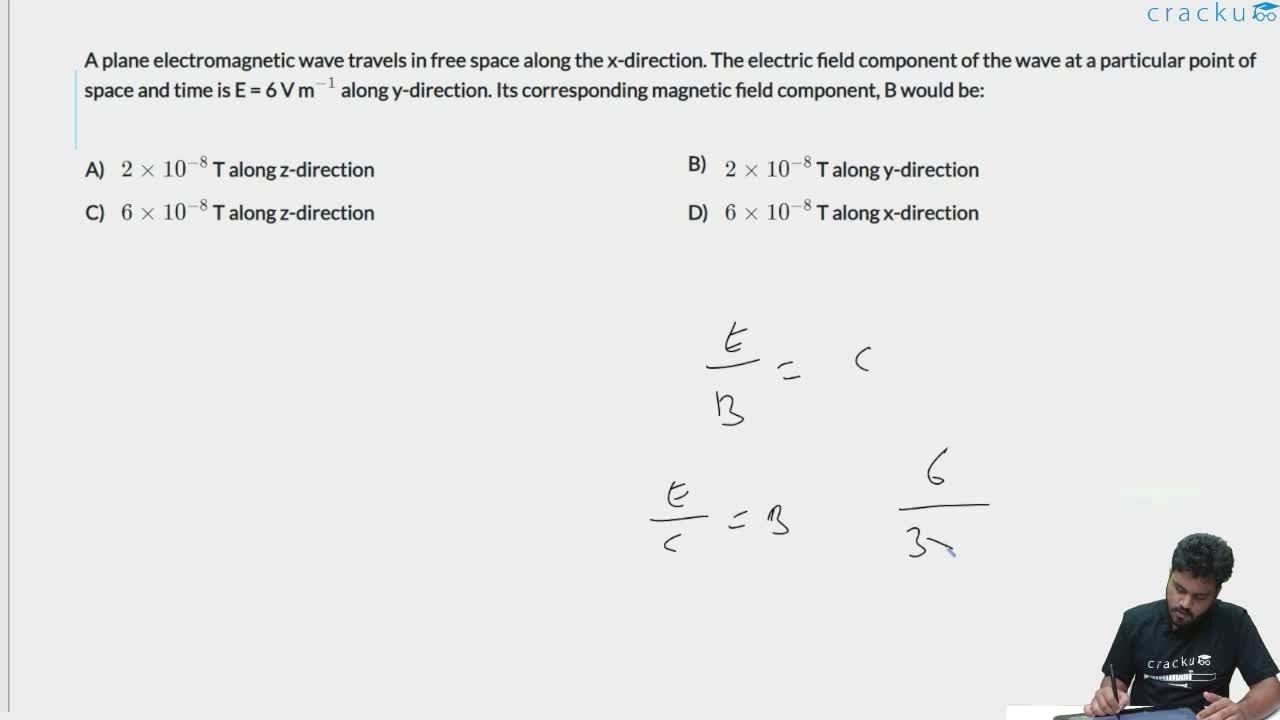
A plane electromagnetic wave travels in free space along the x-direction. The electric field component of the wave at a particular point of space and time is E = 6 V m$$^{-1}$$ along y-direction. Its corresponding magnetic field component, B would be:
We are told that an electromagnetic (EM) plane wave is moving in free space along the $$+x$$-direction. In such a wave, the electric field $$\vec E$$, the magnetic field $$\vec B$$, and the direction of propagation $$\vec k$$ are all mutually perpendicular and satisfy a right-hand rule: $$\vec E \times \vec B = \dfrac{\vec k}{k}\,cB^{2}$$, which in simple language means that if the fingers of the right hand curl from $$\vec E$$ toward $$\vec B$$, the thumb points along the direction in which the wave travels.
Here the electric field at the chosen instant is given as
$$\vec E = 6\;\text{V m}^{-1}\;\hat y$$
and the wave is travelling along $$+x$$, so $$\vec k = k\,\hat x$$. Hence, by the right-hand rule, $$\vec B$$ must be parallel (or anti-parallel) to the $$z$$-axis. Among the answer choices, only the options that put $$\vec B$$ along the $$z$$-direction can be correct regarding orientation.
Next, we need the magnitude of $$\vec B$$. For any EM wave in free space, the electric and magnetic field amplitudes are related by the universal relation
$$\frac{E_0}{B_0} = c,$$
where
$$c = 3 \times 10^{8}\;\text{m s}^{-1}$$
is the speed of light in vacuum. Here $$E_0$$ is the instantaneous magnitude of the electric field (which is given as 6 V m$$^{-1}$$) and $$B_0$$ is the corresponding magnitude of the magnetic field we have to find.
Re-writing the formula to solve for $$B_0$$, we get
$$B_0 = \frac{E_0}{c}.$$
Now we substitute the numbers:
$$B_0 = \frac{6\;\text{V m}^{-1}}{3 \times 10^{8}\;\text{m s}^{-1}}.$$
Carrying out the division step by step, first divide the numerical factors:
$$\frac{6}{3} = 2.$$
Next, treat the powers of ten:
$$\frac{1}{10^{8}} = 10^{-8}.$$
Combining these results, we arrive at
$$B_0 = 2 \times 10^{-8}\;\text{T}.$$
Therefore the magnetic field component equals $$2 \times 10^{-8}\;\text{T}$$ and, as argued earlier, it must lie along the $$z$$-direction to be perpendicular to both $$\hat y$$ (the direction of $$\vec E$$) and $$\hat x$$ (the propagation direction).
Hence, the correct answer is Option A.
Was this solution helpful?
Click on the Email ☝️ to Watch the Video Solution
Create a FREE account and get:
_1.webp)

Educational materials for JEE preparation

Ask our AI anything

AI can make mistakes. Please verify important information.
AI can make mistakes. Please verify important information.
