JEE WhatsApp Group
Sign in
Please select an account to continue using cracku.in
↓ →
JEE WhatsApp Group

Join Our JEE Preparation Group
Prep with like-minded aspirants; Get access to free daily tests and study material.
If P is a point on the circle $$x^{2}+y^{2}=4$$, Q is a point on the straight line 5x + y + 2 = 0 and x- y + 1 = 0 is the perpendicular bisector of PQ, then 13 times the sum of abscissa of all such points P is __________
Correct Answer: 2
Let $$(P(x_1,y_1)$$) lie on the circle and ($$Q(x_2,y_2))$$ on the line.
Circle:
$$x_1^2+y_1^2=4$$
Line for (Q):
$$5x_2+y_2+2=0;\Rightarrow;y_2=-5x_2-2$$
Given perpendicular bisector has slope (1) (since ($$x-y+1=0\Rightarrow y=x+1$$))
So slope of (PQ = -1):
$$\frac{y_2-y_1}{x_2-x_1}=-1\Rightarrow x_2+y_2=x_1+y_1$$
Midpoint lies on bisector
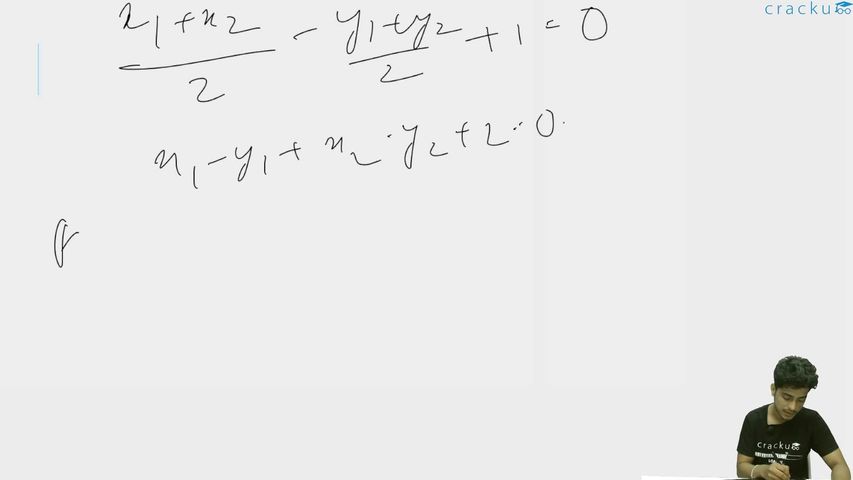
$$\frac{x_1+x_2}{2}-\frac{y_1+y_2}{2}+1=0$$
$$\Rightarrow x_1-y_1+x_2-y_2+2=0$$
From line:
$$x_2+y_2=-4x_2-2$$
$$\Rightarrow-4x_2-2=x_1+y_1$$
Also:
$$x_2-y_2=6x_2+2$$
]Substitute into midpoint equation → simplifies to:
$$x_1=2-5y_1$$
Put into circle:
$$(2-5y)^2+y^2=4$$
$$\Rightarrow y(13y-10)=0$$
$$(y=0\Rightarrow x=2)$$
$$(y=\frac{10}{13}\Rightarrow x=-\frac{24}{13})$$
Sum of abcissas
$$2+\left(-\frac{24}{13}\right)=\frac{2}{13}$$
$$13\times\frac{2}{13}=2$$
Click on the Email ☝️ to Watch the Video Solution
Create a FREE account and get:
_1.webp)

Educational materials for JEE preparation

Ask our AI anything

AI can make mistakes. Please verify important information.
AI can make mistakes. Please verify important information.