
Join Our JEE Preparation Group
Prep with like-minded aspirants; Get access to free daily tests and study material.
Sign in
Please select an account to continue using cracku.in
↓ →
Join Our JEE Preparation Group
Prep with like-minded aspirants; Get access to free daily tests and study material.
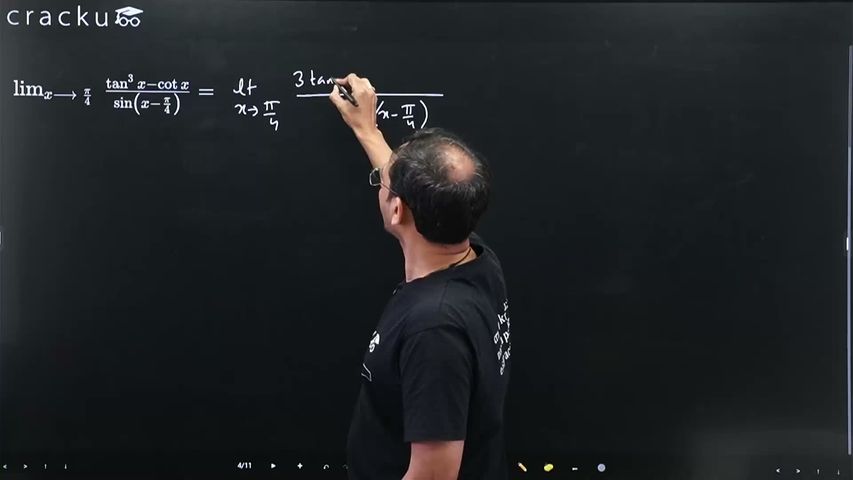
$$\lim_{x\longrightarrow\ \frac{\pi}{4}}\ \frac{\tan^3x-\cot x}{\sin\left(x-\frac{\pi}{4}\right)}=$$
Correct Answer: 8
Substitute $$x = \frac{\pi}{4} + h$$, where $$h \to 0$$.
The denominator becomes:
$$\sin\left(\frac{\pi}{4} + h - \frac{\pi}{4}\right) = \sin h$$
For the numerator, let $$t = \tan h$$.
Using the expansion property for $$\tan\left(\frac{\pi}{4} + h\right) = \frac{1+t}{1-t}$$ and $$\cot\left(\frac{\pi}{4} + h\right) = \frac{1-t}{1+t}$$, we get:
$$\tan^3 x - \cot x = \left(\frac{1+t}{1-t}\right)^3 - \frac{1-t}{1+t}$$
$$= \frac{(1+t)^4 - (1-t)^4}{(1-t)^3(1+t)}$$
Using the algebraic expansion difference $$(1+t)^4 - (1-t)^4 = 8t + 8t^3 = 8t(1+t^2)$$:
$$\text{Numerator} = \frac{8t(1+t^2)}{(1-t)^3(1+t)}$$
Substitute this back into the limit expression:
$$\lim_{h \to 0} \frac{8 \tan h (1 + \tan^2 h)}{(1 - \tan h)^3(1 + \tan h)\sin h}$$
Separate the terms into standard limit forms:
$$= 8 \cdot \left(\lim_{h \to 0} \frac{\tan h}{\sin h}\right) \cdot \left(\lim_{h \to 0} \frac{1 + \tan^2 h}{(1 - \tan h)^3(1 + \tan h)}\right)$$
Since $$\lim_{h \to 0} \frac{\tan h}{\sin h} = 1$$ and as $$h \to 0$$, $$\tan h \to 0$$:
$$= 8 \times 1 \times \frac{1 + 0}{(1 - 0)^3(1 + 0)} = 8$$
Was this solution helpful?
Click on the Email ☝️ to Watch the Video Solution
Create a FREE account and get:
_1.webp)

Educational materials for JEE preparation

Ask our AI anything

AI can make mistakes. Please verify important information.
AI can make mistakes. Please verify important information.
