
Join Our JEE Preparation Group
Prep with like-minded aspirants; Get access to free daily tests and study material.
Sign in
Please select an account to continue using cracku.in
↓ →
Join Our JEE Preparation Group
Prep with like-minded aspirants; Get access to free daily tests and study material.
A hydraulic press can lift 100 kg when a mass $$m$$ is placed on the smaller piston. It can lift ______ kg when the diameter of the larger piston is increased by 4 times and that of the smaller piston is decreased by 4 times keeping the same mass $$m$$ on the smaller piston.
Correct Answer: 25600
We have a hydraulic press where a mass $$m$$ on the smaller piston can lift 100 kg on the larger piston. By Pascal's law, the pressure is transmitted equally, so $$\frac{F_1}{A_1} = \frac{F_2}{A_2}$$.
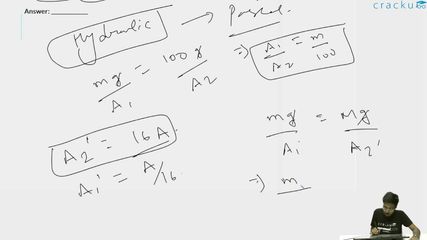
Let the original diameters of the smaller and larger pistons be $$d$$ and $$D$$ respectively. Then $$\frac{mg}{A_1} = \frac{100g}{A_2}$$, which gives $$\frac{A_2}{A_1} = \frac{100}{m}$$.
Now, the diameter of the larger piston is increased by 4 times to $$4D$$, and the diameter of the smaller piston is decreased by 4 times to $$\frac{d}{4}$$.
The new area of the larger piston is $$A_2' = \frac{\pi(4D)^2}{4} = 16 \times \frac{\pi D^2}{4} = 16A_2$$.
The new area of the smaller piston is $$A_1' = \frac{\pi(d/4)^2}{4} = \frac{1}{16} \times \frac{\pi d^2}{4} = \frac{A_1}{16}$$.
Using Pascal's law with the same mass $$m$$ on the smaller piston: $$\frac{mg}{A_1'} = \frac{Mg}{A_2'}$$, where $$M$$ is the new mass that can be lifted.
$$M = m \times \frac{A_2'}{A_1'} = m \times \frac{16A_2}{A_1/16} = m \times 256 \times \frac{A_2}{A_1}$$
We know $$m \times \frac{A_2}{A_1} = 100$$, so $$M = 256 \times 100 = 25600$$ kg.
So, the answer is $$25600$$.
Was this solution helpful?
Click on the Email ☝️ to Watch the Video Solution
Create a FREE account and get:
_1.webp)

Educational materials for JEE preparation

Ask our AI anything

AI can make mistakes. Please verify important information.
AI can make mistakes. Please verify important information.


