
Join Our JEE Preparation Group
Prep with like-minded aspirants; Get access to free daily tests and study material.
Sign in
Please select an account to continue using cracku.in
↓ →
Join Our JEE Preparation Group
Prep with like-minded aspirants; Get access to free daily tests and study material.
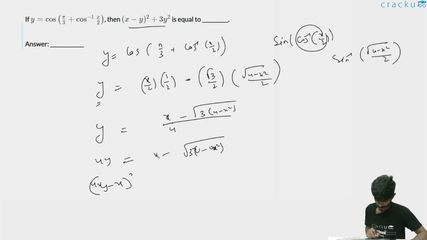
If $$y = \cos\left(\frac{\pi}{3} + \cos^{-1}\frac{x}{2}\right)$$, then $$(x - y)^2 + 3y^2$$ is equal to __________.
Correct Answer: 3
Let $$\theta = \cos^{-1}\frac{x}{2}$$. By definition, $$\cos\theta = \frac{x}{2}$$ and $$-2 \le x \le 2$$.
Using $$\sin^2\theta + \cos^2\theta = 1$$ gives
$$\sin\theta = \sqrt{1-\cos^2\theta} = \sqrt{1-\left(\frac{x}{2}\right)^2} = \frac{\sqrt{4 - x^{2}}}{2}\,.$$
The given function is $$y = \cos\left(\frac{\pi}{3} + \theta\right)$$.
Apply the cosine addition formula
$$\cos(A+B) = \cos A \cos B - \sin A \sin B$$ with $$A = \frac{\pi}{3}$$ and $$B = \theta$$:
$$y = \cos\frac{\pi}{3}\,\cos\theta \;-\; \sin\frac{\pi}{3}\,\sin\theta.$$
Substitute $$\cos\frac{\pi}{3} = \frac12,\; \sin\frac{\pi}{3} = \frac{\sqrt3}{2},\; \cos\theta = \frac{x}{2},\; \sin\theta = \frac{\sqrt{4-x^{2}}}{2}$$:
$$y = \frac12 \cdot \frac{x}{2} \;-\; \frac{\sqrt3}{2} \cdot \frac{\sqrt{4-x^{2}}}{2} = \frac{x}{4} \;-\; \frac{\sqrt3}{4}\sqrt{4-x^{2}} = \frac14\Bigl(x - \sqrt3\,\sqrt{4-x^{2}}\Bigr).$$
Compute $$x - y$$:
$$x - y = x - \frac14\Bigl(x - \sqrt3\,\sqrt{4-x^{2}}\Bigr) = \frac34\,x + \frac{\sqrt3}{4}\sqrt{4-x^{2}} = \frac14\Bigl(3x + \sqrt3\,\sqrt{4-x^{2}}\Bigr).$$
Square both expressions.
Case 1: $$(x - y)^2$$ $$\begin{aligned} (x - y)^2 &= \left[\frac14\Bigl(3x + \sqrt3\,\sqrt{4-x^{2}}\Bigr)\right]^2 \\ &= \frac1{16}\Bigl(3x + \sqrt3\,\sqrt{4-x^{2}}\Bigr)^2 \\ &= \frac1{16}\Bigl(9x^{2} + 6\sqrt3\,x\,\sqrt{4-x^{2}} + 3(4 - x^{2})\Bigr) \\ &= \frac1{16}\Bigl(6x^{2} + 6\sqrt3\,x\,\sqrt{4-x^{2}} + 12\Bigr) \\ &= \frac{3}{8}\Bigl(x^{2} + \sqrt3\,x\,\sqrt{4-x^{2}} + 2\Bigr). \end{aligned}$$
Case 2: $$y^{2}$$ $$\begin{aligned} y^{2} &= \left[\frac14\Bigl(x - \sqrt3\,\sqrt{4-x^{2}}\Bigr)\right]^2 \\ &= \frac1{16}\Bigl(x - \sqrt3\,\sqrt{4-x^{2}}\Bigr)^2 \\ &= \frac1{16}\Bigl(x^{2} - 2\sqrt3\,x\,\sqrt{4-x^{2}} + 3(4 - x^{2})\Bigr) \\ &= \frac1{16}\Bigl(-2x^{2} - 2\sqrt3\,x\,\sqrt{4-x^{2}} + 12\Bigr). \end{aligned}$$
Multiply by 3:
$$3y^{2} = \frac{1}{16}\Bigl(-6x^{2} - 6\sqrt3\,x\,\sqrt{4-x^{2}} + 36\Bigr).$$
Add the two results:
$$\begin{aligned} (x - y)^2 + 3y^{2} &= \frac{3}{8}\Bigl(x^{2} + \sqrt3\,x\,\sqrt{4-x^{2}} + 2\Bigr) + \frac{1}{16}\Bigl(-6x^{2} - 6\sqrt3\,x\,\sqrt{4-x^{2}} + 36\Bigr) \\[4pt] &= \frac{6}{16}\Bigl(x^{2} + \sqrt3\,x\,\sqrt{4-x^{2}} + 2\Bigr) + \frac{1}{16}\Bigl(-6x^{2} - 6\sqrt3\,x\,\sqrt{4-x^{2}} + 36\Bigr) \\[4pt] &= \frac{6}{16}\Bigl(x^{2} + \sqrt3\,x\,\sqrt{4-x^{2}} + 2 - x^{2} - \sqrt3\,x\,\sqrt{4-x^{2}} + 6\Bigr) \\[4pt] &= \frac{6}{16}\Bigl(8\Bigr) = \frac{48}{16} = 3. \end{aligned}$$
Thus $$(x - y)^2 + 3y^2 = 3$$ for every $$x$$ in the domain $$[-2,2]$$.
Final Answer: 3
Was this solution helpful?
Click on the Email ☝️ to Watch the Video Solution
Create a FREE account and get:
_1.webp)

Educational materials for JEE preparation

Ask our AI anything

AI can make mistakes. Please verify important information.
AI can make mistakes. Please verify important information.


