
Join Our JEE Preparation Group
Prep with like-minded aspirants; Get access to free daily tests and study material.
Sign in
Please select an account to continue using cracku.in
↓ →
Join Our JEE Preparation Group
Prep with like-minded aspirants; Get access to free daily tests and study material.
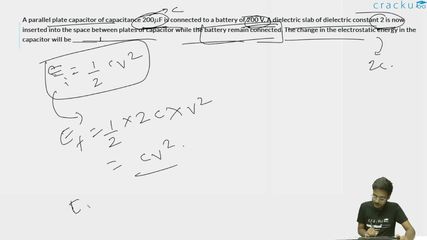
A parallel plate capacitor of capacitance 200$$\mu$$F is connected to a battery of 200 V. A dielectric slab of dielectric constant 2 is now inserted into the space between plates of capacitor while the battery remain connected. The change in the electrostatic energy in the capacitor will be _________ J.
Correct Answer: 4
We have a parallel-plate capacitor whose initial capacitance is given as $$C_0 = 200\;\mu\text{F} = 200 \times 10^{-6}\,\text{F}.$$
This capacitor is connected across a constant battery of potential difference $$V = 200\;\text{V},$$ and the battery remains connected throughout the process. Because the battery is always attached, the voltage across the plates stays fixed at 200 V even after any change in the capacitor.
First, let us determine the energy stored in the capacitor before inserting the dielectric. The expression for electrostatic energy of a capacitor at constant voltage is stated as $$U = \tfrac12 C V^{2}.$$ Substituting the initial values, we get $$U_i = \tfrac12 \, C_0 \, V^{2} = \tfrac12 \left(200 \times 10^{-6}\,\text{F}\right) \left(200\,\text{V}\right)^{2}.$$
Now, $$\left(200\,\text{V}\right)^{2} = 200^{2} = 40\,000.$$ So, $$U_i = \tfrac12 \left(200 \times 10^{-6}\right) \left(40\,000\right) = \tfrac12 \left(200 \times 40\,000 \times 10^{-6}\right).$$
Multiplying inside the parenthesis: $$200 \times 40\,000 = 8\,000\,000.$$ Thus, $$U_i = \tfrac12 \left(8\,000\,000 \times 10^{-6}\right) = \tfrac12 \left(8\right) = 4\;\text{J}.$$
Next, a dielectric slab of dielectric constant $$k = 2$$ is inserted completely between the plates. When a dielectric fills the entire space, the new capacitance is given by the known relation $$C_f = k\,C_0.$$ Hence, $$C_f = 2 \times 200 \times 10^{-6}\,\text{F} = 400 \times 10^{-6}\,\text{F}.$$
Because the battery is still connected, the voltage remains $$V = 200\;\text{V}.$$ We again use the same energy formula for the final state: $$U_f = \tfrac12 C_f V^{2} = \tfrac12 \left(400 \times 10^{-6}\,\text{F}\right) \left(200\,\text{V}\right)^{2}.$$
We already evaluated $$V^{2} = 40\,000.$$ Hence, $$U_f = \tfrac12 \left(400 \times 10^{-6} \times 40\,000\right) = \tfrac12 \left(400 \times 40\,000 \times 10^{-6}\right).$$
Compute the product inside: $$400 \times 40\,000 = 16\,000\,000.$$ Therefore, $$U_f = \tfrac12 \left(16\,000\,000 \times 10^{-6}\right) = \tfrac12 \left(16\right) = 8\;\text{J}.$$
The change in electrostatic energy is the difference between the final and initial energies: $$\Delta U = U_f - U_i = 8\;\text{J} - 4\;\text{J} = 4\;\text{J}.$$
So, the answer is $$4\;\text{J}$$.
Was this solution helpful?
Click on the Email ☝️ to Watch the Video Solution
Create a FREE account and get:
_1.webp)

Educational materials for JEE preparation

Ask our AI anything

AI can make mistakes. Please verify important information.
AI can make mistakes. Please verify important information.
