
Join Our JEE Preparation Group
Prep with like-minded aspirants; Get access to free daily tests and study material.
Sign in
Please select an account to continue using cracku.in
↓ →
Join Our JEE Preparation Group
Prep with like-minded aspirants; Get access to free daily tests and study material.
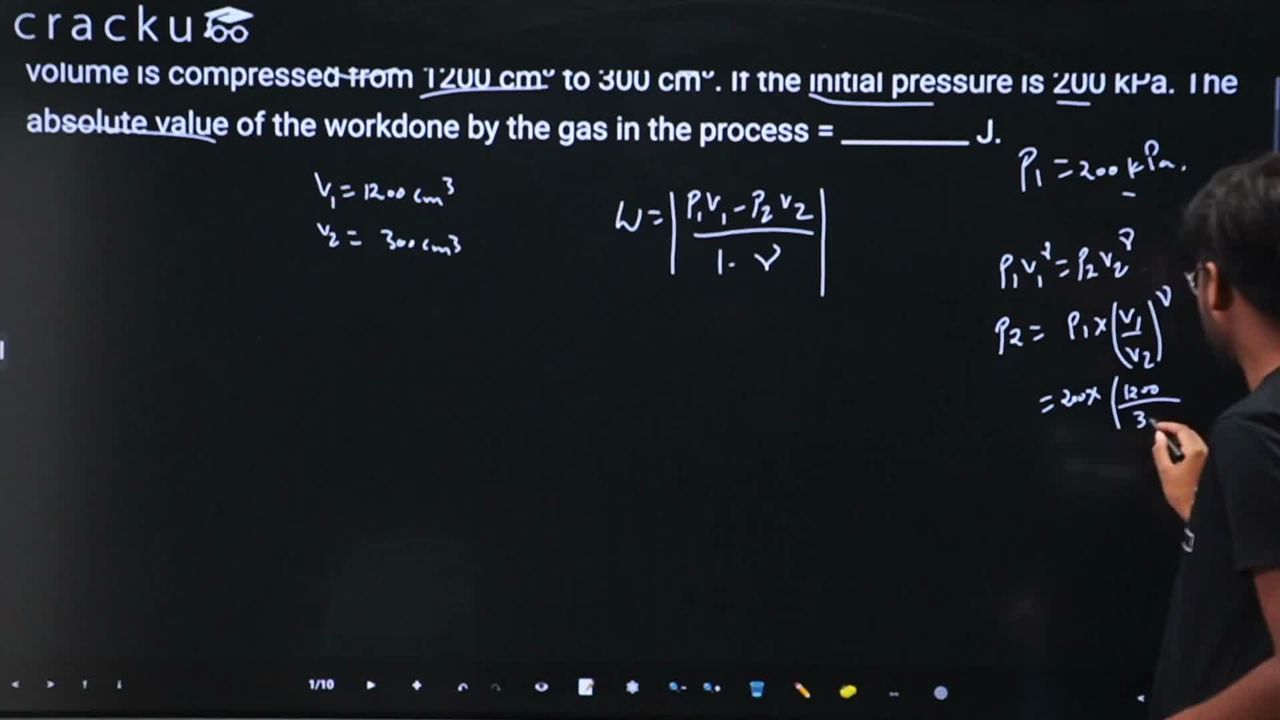
A sample of gas with $$\gamma = 1.5$$ is taken through an adiabatic process in which the volume is compressed from 1200 cm$$^3$$ to 300 cm$$^3$$. If the initial pressure is 200 kPa. The absolute value of the workdone by the gas in the process = _________ J.
Correct Answer: 480
For an adiabatic process of an ideal gas we always have the relation
$$P\,V^{\gamma}= \text{constant}.$$
The work done by the gas (positive for expansion, negative for compression) in a reversible adiabatic process is given by the formula
$$W=\frac{P_2V_2-P_1V_1}{1-\gamma}=\frac{P_1V_1-P_2V_2}{\gamma-1}.$$
Here the given data are
$$\gamma = 1.5, \quad V_1 = 1200\ \text{cm}^3, \quad V_2 = 300\ \text{cm}^3, \quad P_1 = 200\ \text{kPa}.$$
First we convert the volumes into SI units (m$$^3$$):
$$V_1 = 1200\ \text{cm}^3 = 1200\times10^{-6}\ \text{m}^3 = 1.2\times10^{-3}\ \text{m}^3,$$
$$V_2 = 300\ \text{cm}^3 = 300\times10^{-6}\ \text{m}^3 = 3.0\times10^{-4}\ \text{m}^3.$$
Using $$P_1V_1^{\gamma}=P_2V_2^{\gamma},$$ we find the final pressure:
$$P_2=P_1\left(\frac{V_1}{V_2}\right)^{\gamma}.$$
The volume ratio is
$$\frac{V_1}{V_2}= \frac{1.2\times10^{-3}}{3.0\times10^{-4}} = 4,$$ so
$$P_2 = 200\ \text{kPa}\;\bigl(4\bigr)^{1.5}.$$
Because $$4^{1.5}=4^{3/2}=(4^1)(4^{1/2})=4\times2=8,$$ we obtain
$$P_2 = 200\ \text{kPa}\times 8 = 1600\ \text{kPa}.$$
Next we calculate the products $$P_1V_1$$ and $$P_2V_2,$$ remembering that $$1\ \text{kPa}=10^{3}\ \text{Pa}$$ and $$1\ \text{Pa}\cdot\text{m}^3=1\ \text{J}.$$
$$P_1V_1 = 200\ \text{kPa}\times1.2\times10^{-3}\ \text{m}^3 = 200\times10^{3}\ \text{Pa}\times1.2\times10^{-3}\ \text{m}^3$$
$$\phantom{P_1V_1} = 200\times1.2\times(10^{3}\times10^{-3})\ \text{J} = 240\ \text{J}.$$
$$P_2V_2 = 1600\ \text{kPa}\times3.0\times10^{-4}\ \text{m}^3 = 1600\times10^{3}\ \text{Pa}\times3.0\times10^{-4}\ \text{m}^3$$
$$\phantom{P_2V_2} = 1600\times3.0\times(10^{3}\times10^{-4})\ \text{J} = 480\ \text{J}.$$
Substituting these values into the work formula that is convenient for magnitude,
$$W = \left|\frac{P_1V_1-P_2V_2}{\gamma-1}\right|,$$
we have
$$P_1V_1-P_2V_2 = 240\ \text{J}-480\ \text{J} = -240\ \text{J},$$
and since $$\gamma-1 = 1.5-1 = 0.5,$$
$$W = \left|\frac{-240\ \text{J}}{0.5}\right| = \left|-480\ \text{J}\right| = 480\ \text{J}.$$
The negative sign merely indicated that the gas was compressed; the question asks for the absolute value, which is 480 J.
So, the answer is $$480\ \text{J}.$$
Click on the Email ☝️ to Watch the Video Solution
Create a FREE account and get:
_1.webp)

Educational materials for JEE preparation

Ask our AI anything

AI can make mistakes. Please verify important information.
AI can make mistakes. Please verify important information.


