
Join Our JEE Preparation Group
Prep with like-minded aspirants; Get access to free daily tests and study material.
Sign in
Please select an account to continue using cracku.in
↓ →
Join Our JEE Preparation Group
Prep with like-minded aspirants; Get access to free daily tests and study material.
Two players $$A$$ and $$B$$ play a series of badminton games. The first player, who wins 5 games first, wins the series. Assuming that no game ends in a draw, the number of ways in which player $$A$$ wins the series is :_____.
Correct Answer: 126
To find the number of ways player $$A$$ can win the series, we need to consider all the different scenarios based on the total number of games played.
Since the first player to win 5 games wins the series, the series can last anywhere from 5 games to a maximum of 9 games (because if they played 10 games, one player would have already reached 5 wins).
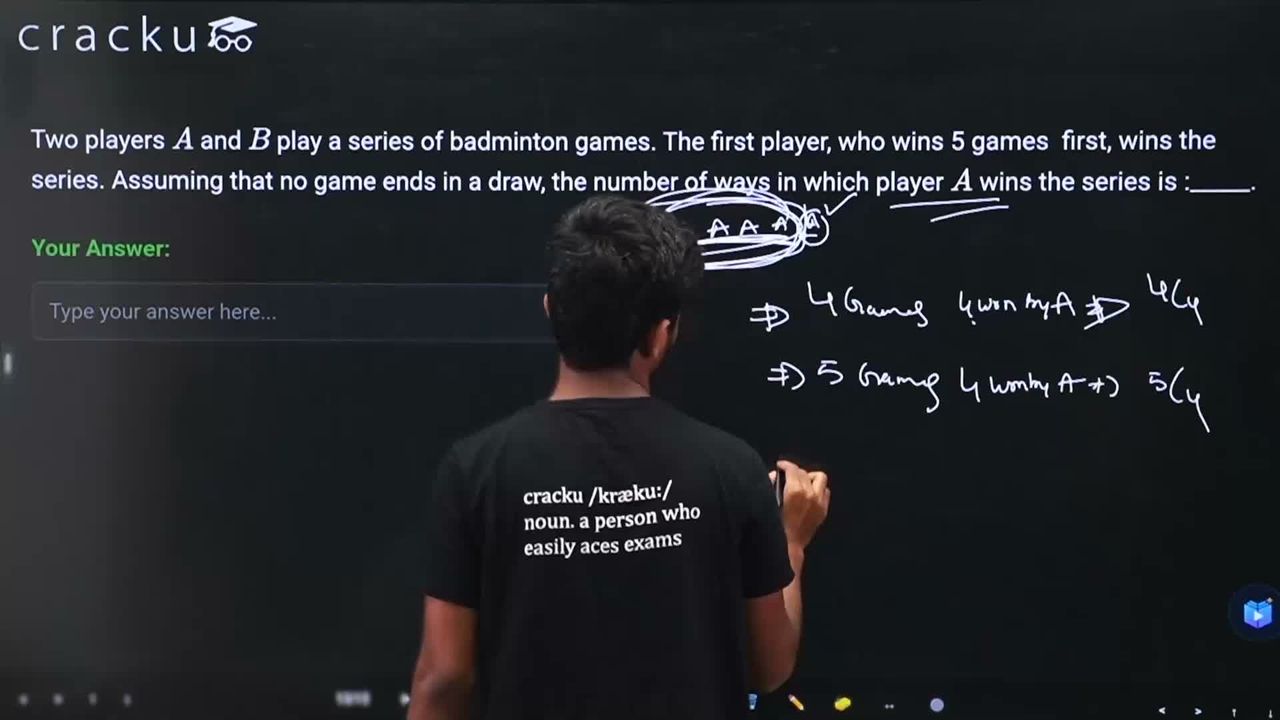
For player $$A$$ to win in exactly $$n$$ games, player $$A$$ must win the very last game (the $$n^{th}$$ game). This means in the preceding $$n-1$$ games, player $$A$$ must have won exactly 4 games.
We sum the number of ways for $$A$$ to win for each possible series length:
Total Games (n) |
Wins for A in first n−1 games |
Calculation: (4n−1) |
Number of Ways |
5 Games |
4 wins in 4 games |
$$\binom{4}{4}$$ |
1 |
6 Games |
4 wins in 5 games |
$$\binom{5}{4}$$ |
5 |
7 Games |
4 wins in 6 games |
$$\binom{6}{4}$$ |
15 |
8 Games |
4 wins in 7 games |
$$\binom{7}{4}$$ |
35 |
9 Games |
4 wins in 8 games |
$$\binom{8}{4}$$ |
70 |
Now, we add these individual scenarios together:
$$\text{Total} = 1 + 5 + 15 + 35 + 70$$
$$\text{Total} = 126$$
The number of ways in which player $$A$$ wins the series is 126.
Was this solution helpful?
Click on the Email ☝️ to Watch the Video Solution
Create a FREE account and get:
_1.webp)

Educational materials for JEE preparation

Ask our AI anything

AI can make mistakes. Please verify important information.
AI can make mistakes. Please verify important information.


