
Join Our JEE Preparation Group
Prep with like-minded aspirants; Get access to free daily tests and study material.
Sign in
Please select an account to continue using cracku.in
↓ →
Join Our JEE Preparation Group
Prep with like-minded aspirants; Get access to free daily tests and study material.
Let $$A = \{1, 2, 3, 4, 5, 6\}$$. The number of one-one functions $$f: A \to A$$ such that $$f(1) \geq 3$$, $$f(3) \leq 4$$, and $$f(2) + f(3) = 5$$ is :
Correct Answer: 72
To solve for the number of one-one functions $$f: A \rightarrow A$$, we need to satisfy three specific conditions while ensuring no two elements in $$A = \{1, 2, 3, 4, 5, 6\}$$ map to the same image.
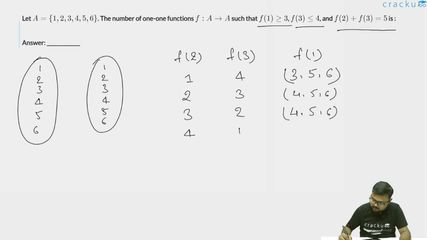
Since $$f: A \rightarrow A$$, the values for $$f(2)$$ and $$f(3)$$ must be distinct elements from the set $$\{1, 2, 3, 4, 5, 6\}$$. The pairs $$(f(2), f(3))$$ that sum to 5 are:
All four cases above satisfy $$f(3) \le 4$$. Now we calculate the number of choices for $$f(1)$$ for each case, keeping in mind that $$f$$ is a one-one function (so $$f(1)$$ cannot equal $$f(2)$$ or $$f(3)$$).
Case |
f(2) |
f(3) |
Possible values for f(1)∈{3,4,5,6} |
No. of choices for f(1) |
1 |
1 |
4 |
$$\{3, 5, 6\}$$ (excluding 4) |
3 |
2 |
4 |
1 |
$$\{3, 5, 6\}$$ (excluding 4) |
3 |
3 |
2 |
3 |
$$\{4, 5, 6\}$$ (excluding 3) |
3 |
4 |
3 |
2 |
$$\{4, 5, 6\}$$ (excluding 3) |
3 |
Total ways to assign $$f(1), f(2), \text{ and } f(3)$$:
$$3 + 3 + 3 + 3 = 12$$ ways.
For each of the 12 ways identified above, we have 3 elements left in the domain $$\{4, 5, 6\}$$ and 3 elements remaining in the codomain. Since the function is one-one, these 3 elements can be mapped in $$3!$$ ways.
$$3! = 3 \times 2 \times 1 = 6 \text{ ways}$$
Total number of one-one functions = (Ways to pick $$f(1), f(2), f(3)$$) $$\times$$ (Ways to arrange remaining elements)
$$\text{Total} = 12 \times 6 = 72$$
Final Answer: 72
Was this solution helpful?
Click on the Email ☝️ to Watch the Video Solution
Create a FREE account and get:
_1.webp)

Educational materials for JEE preparation

Ask our AI anything

AI can make mistakes. Please verify important information.
AI can make mistakes. Please verify important information.


