
Join Our JEE Preparation Group
Prep with like-minded aspirants; Get access to free daily tests and study material.
Sign in
Please select an account to continue using cracku.in
↓ →
Join Our JEE Preparation Group
Prep with like-minded aspirants; Get access to free daily tests and study material.
Let the domain of the function $$f(x) = \cos^{-1}\left(\frac{4x+5}{3x-7}\right)$$ be $$[\alpha, \beta]$$ and the domain of $$g(x) = \log_2(2 - 6\log_{27}(2x+5))$$ be $$(\gamma, \delta)$$. Then $$|7(\alpha + \beta) + 4(\gamma + \delta)|$$ is equal to _____.
Correct Answer: 96
Given the domain of the function $$f(x) = \cos^{-1}\left(\frac{4x+5}{3x-7}\right)$$ is $$[\alpha, \beta]$$. The domain of the inverse cosine function is $$[-1, 1]$$, we get:
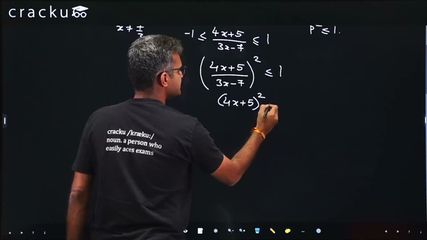
$$-1 \le \frac{4x+5}{3x-7} \le 1$$
From the inequality $$\frac{4x+5}{3x-7} \le 1$$:
$$\frac{4x+5}{3x-7} - 1 \le 0 \implies \frac{4x+5 - (3x-7)}{3x-7} \le 0 \implies \frac{x+12}{3x-7} \le 0$$
The critical points are $$x = -12$$ and $$x = \frac{7}{3}$$. This gives:
$$x \in \left[-12, \frac{7}{3}\right)$$
From the inequality $$\frac{4x+5}{3x-7} \ge -1$$:
$$\frac{4x+5}{3x-7} + 1 \ge 0 \implies \frac{4x+5 + (3x-7)}{3x-7} \ge 0 \implies \frac{7x-2}{3x-7} \ge 0$$
The critical points are $$x = \frac{2}{7}$$ and $$x = \frac{7}{3}$$. This gives:
$$x \in \left(-\infty, \frac{2}{7}\right] \cup \left(\frac{7}{3}, \infty\right)$$
Taking the intersection of both intervals gives the domain of $$f(x)$$:
$$\text{Domain of } f(x) = \left[-12, \frac{2}{7}\right]$$
Comparing this with $$[\alpha, \beta]$$, we get:
$$\alpha = -12, \quad \beta = \frac{2}{7}$$
$$7(\alpha + \beta) = 7\left(-12 + \frac{2}{7}\right) = -84 + 2 = -82$$
---
Given the domain of the function $$g(x) = \log_2(2 - 6\log_{27}(2x+5))$$ is $$(\gamma, \delta)$$. For the log functions to be defined, their arguments must be strictly positive.
From the inner log argument:
$$2x + 5 > 0 \implies x > -\frac{5}{2}$$
From the outer log argument:
$$2 - 6\log_{27}(2x+5) > 0 \implies 6\log_{27}(2x+5) < 2 \implies \log_{27}(2x+5) < \frac{1}{3}$$
Converting to exponential form:
$$2x + 5 < (27)^{\frac{1}{3}} \implies 2x + 5 < 3 \implies 2x < -2 \implies x < -1$$
Taking the intersection of both conditions gives the domain of $$g(x)$$:
$$\text{Domain of } g(x) = \left(-\frac{5}{2}, -1\right)$$
Comparing this with $$(\gamma, \delta)$$, we get:
$$\gamma = -\frac{5}{2}, \quad \delta = -1$$
$$4(\gamma + \delta) = 4\left(-\frac{5}{2} - 1\right) = 4\left(-\frac{7}{2}\right) = -14$$
---
Now, substituting these values into the required expression:
$$\left|7(\alpha + \beta) + 4(\gamma + \delta)\right| = |-82 - 14| = |-96| = 96$$
Therefore, the final value is equal to 96.
Was this solution helpful?
Click on the Email ☝️ to Watch the Video Solution
Create a FREE account and get:
_1.webp)

Educational materials for JEE preparation

Ask our AI anything

AI can make mistakes. Please verify important information.
AI can make mistakes. Please verify important information.
