
Join Our JEE Preparation Group
Prep with like-minded aspirants; Get access to free daily tests and study material.
Sign in
Please select an account to continue using cracku.in
↓ →
Join Our JEE Preparation Group
Prep with like-minded aspirants; Get access to free daily tests and study material.
An inclined plane is bent in such a way that the vertical cross-section is given by $$y = \frac{x^2}{4}$$ where $$y$$ is in vertical and $$x$$ in horizontal direction. If the upper surface of this curved plane is rough with coefficient of friction $$\mu = 0.5$$, the maximum height in cm at which a stationary block will not slip downward is ______ cm.
Correct Answer: 25
We have a curved inclined plane whose vertical cross-section is given by $$y = \frac{x^2}{4}$$. The coefficient of friction is $$\mu = 0.5$$.
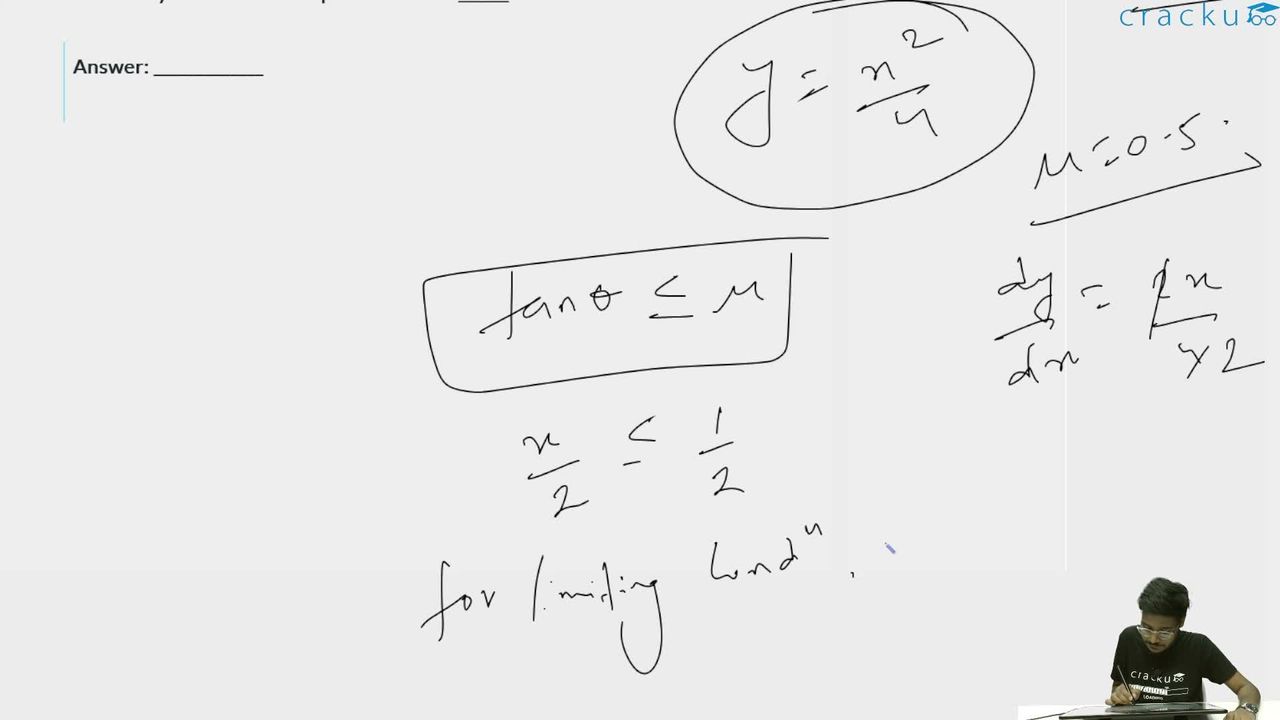
At any point on the curve, the slope of the tangent gives the angle of inclination $$\theta$$ with the horizontal. We find the slope by differentiating: $$\frac{dy}{dx} = \frac{2x}{4} = \frac{x}{2}$$.
Now, $$\tan\theta = \frac{dy}{dx} = \frac{x}{2}$$.
A stationary block will not slip as long as the component of gravity along the surface does not exceed the maximum static friction. This condition is $$\tan\theta \leq \mu$$.
Substituting, we get $$\frac{x}{2} \leq 0.5$$, which gives $$x \leq 1$$.
The maximum height is reached when $$x = 1$$. Substituting into the equation of the curve, $$y = \frac{1^2}{4} = \frac{1}{4} = 0.25$$ m.
Converting to centimetres, $$y = 0.25 \times 100 = 25$$ cm.
So, the answer is $$25$$.
Was this solution helpful?
Click on the Email ☝️ to Watch the Video Solution
Create a FREE account and get:
_1.webp)

Educational materials for JEE preparation

Ask our AI anything

AI can make mistakes. Please verify important information.
AI can make mistakes. Please verify important information.


