
Join Our JEE Preparation Group
Prep with like-minded aspirants; Get access to free daily tests and study material.
Sign in
Please select an account to continue using cracku.in
↓ →
Join Our JEE Preparation Group
Prep with like-minded aspirants; Get access to free daily tests and study material.
A solid cylinder of length is suspended symmetrically through two massless strings, as shown in the figure.
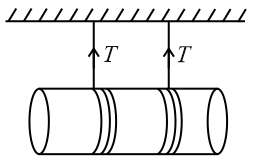
The distance from the initial rest position, the cylinder should be unbinding the strings to achieve a speed of $$4 \ m s^{-1}$$, is _____ cm. (take $$g = 10 \ m s^{-2}$$)
Correct Answer: 120
We need to find the downward distance ($$h$$) the solid cylinder must fall while unbinding from the two strings to achieve a linear center-of-mass speed of $$4\text{ m s}^{-1}$$.
As the cylinder falls, it undergoes combined translational and rotational motion. Since the strings are wrapped around it and unbind without slipping, the system obeys the principle of Conservation of Mechanical Energy.
The potential energy lost by the cylinder during its descent is entirely converted into translational kinetic energy and rotational kinetic energy:
$$\Delta U = K_{\text{trans}} + K_{\text{rot}}$$
$$mgh = \frac{1}{2}mv^2 + \frac{1}{2}I\omega^2$$
$$I = \frac{1}{2}mR^2$$
$$\omega = \frac{v}{R}$$
Substitute the expressions for $$I$$ and $$\omega$$ into the kinetic energy terms:
$$mgh = \frac{1}{2}mv^2 + \frac{1}{2}\left(\frac{1}{2}mR^2\right)\left(\frac{v}{R}\right)^2$$
$$mgh = \frac{1}{2}mv^2 + \frac{1}{4}mv^2$$
Combine the kinetic energy fractions:
$$mgh = \frac{3}{4}mv^2$$
The mass ($$m$$) cancels out from both sides of the equation, leaving:
$$gh = \frac{3}{4}v^2$$
Isolate $$h$$ and substitute the given values into the equation:
$$h = \frac{3v^2}{4g}$$
$$h = \frac{3 \times (4)^2}{4 \times 10}$$
$$h = \frac{3 \times 16}{40} = \frac{48}{40} = 1.2\text{ m}$$
Convert the distance from meters to centimeters:
$$h = 1.2 \times 100 = 120\text{ cm}$$
The distance from the initial rest position that the cylinder should descend is 120 cm.
Was this solution helpful?
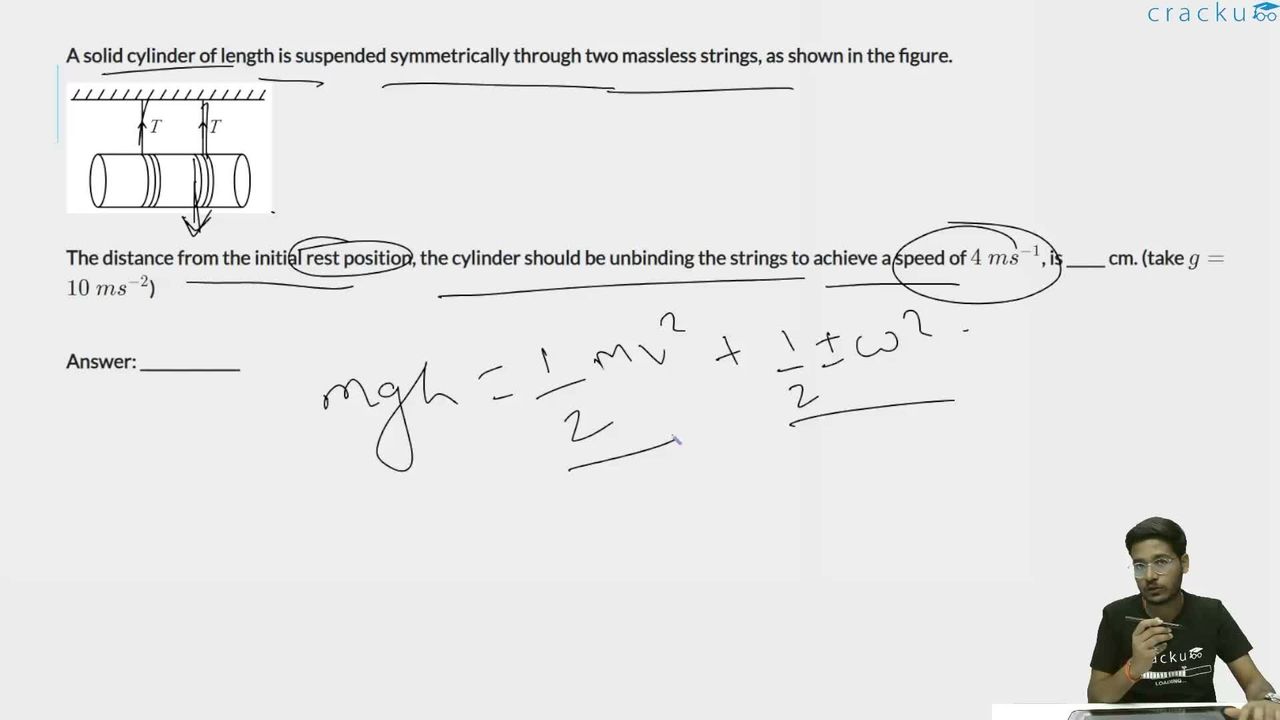
Click on the Email ☝️ to Watch the Video Solution
Create a FREE account and get:
_1.webp)

Educational materials for JEE preparation

Ask our AI anything

AI can make mistakes. Please verify important information.
AI can make mistakes. Please verify important information.
