
Join Our JEE Preparation Group
Prep with like-minded aspirants; Get access to free daily tests and study material.
Sign in
Please select an account to continue using cracku.in
↓ →
Join Our JEE Preparation Group
Prep with like-minded aspirants; Get access to free daily tests and study material.
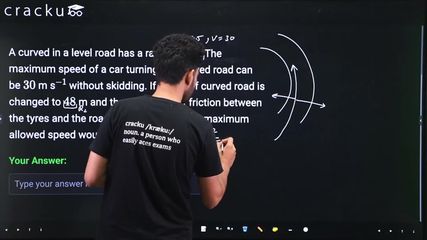
A curved in a level road has a radius $$75$$ m. The maximum speed of a car turning this curved road can be $$30$$ m s$$^{-1}$$ without skidding. If radius of curved road is changed to $$48$$ m and the coefficient of friction between the tyres and the road remains same, then maximum allowed speed would be ______ m s$$^{-1}$$.
Correct Answer: 24
For the first curved road the radius is $$R_1 = 75$$ m and the maximum speed is $$v_1 = 30$$ m/s, while for the second curved road the radius is $$R_2 = 48$$ m and the maximum speed $$v_2$$ is to be determined.
On a level curved road without skidding the centripetal force must equal the frictional force, so $$\frac{mv^2}{R} = \mu mg$$, which gives $$v_{\max} = \sqrt{\mu g R}$$.
From the first case we have $$v_1 = \sqrt{\mu g R_1}$$, and substituting $$30 = \sqrt{\mu \times g \times 75}$$ allows the determination of the coefficient of friction µ, but since µ and g remain the same for both curves, one can write the speeds ratio as $$\frac{v_2}{v_1} = \sqrt{\frac{R_2}{R_1}}$$.
Substituting $$v_1 = 30$$ m/s, $$R_1 = 75$$ m and $$R_2 = 48$$ m gives $$v_2 = v_1 \sqrt{\frac{R_2}{R_1}} = 30 \times \sqrt{\frac{48}{75}}$$, which simplifies to $$v_2 = 30 \times \sqrt{\frac{16}{25}} = 30 \times \frac{4}{5}$$, yielding $$v_2 = 24 \text{ m/s}$$.
Hence, the maximum allowed speed is 24 m/s.
Was this solution helpful?
Click on the Email ☝️ to Watch the Video Solution
Create a FREE account and get:
_1.webp)

Educational materials for JEE preparation

Ask our AI anything

AI can make mistakes. Please verify important information.
AI can make mistakes. Please verify important information.


