
Join Our JEE Preparation Group
Prep with like-minded aspirants; Get access to free daily tests and study material.
Sign in
Please select an account to continue using cracku.in
↓ →
Join Our JEE Preparation Group
Prep with like-minded aspirants; Get access to free daily tests and study material.
Let $$S = \left\{x : \cos^{-1} x = \pi + \sin^{-1} x+\sin^{-1}(2x+1)\right\}$$. Then $$\sum_{x \in S}^{}(2x-1)^{2}$$ is equal to_________.
Correct Answer: 5
For $$\cos^{-1} x$$: we need $$-1 \le x \le 1$$.
For $$\sin^{-1} x$$: we need $$-1 \le x \le 1$$.
For $$\sin^{-1}(2x+1)$$: we need $$-1 \le 2x+1 \le 1$$, i.e., $$-1 \le x \le 0$$.
So the domain is $$x \in [-1, 0]$$.
Substituting $$\cos^{-1} x = \dfrac{\pi}{2} - \sin^{-1} x$$:
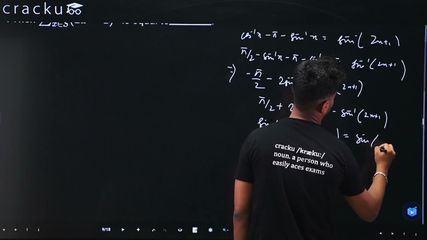
$$\frac{\pi}{2} - \sin^{-1} x = \pi + \sin^{-1} x + \sin^{-1}(2x+1)$$
$$-\frac{\pi}{2} = 2\sin^{-1} x + \sin^{-1}(2x+1)$$
$$\sin^{-1}(2x+1) = -\frac{\pi}{2} - 2\sin^{-1} x$$
$$2x+1 = \sin\left(-\frac{\pi}{2} - 2\sin^{-1} x\right) = -\sin\left(\frac{\pi}{2} + 2\sin^{-1} x\right) = -\cos(2\sin^{-1} x)$$
Let $$\theta = \sin^{-1} x$$, so $$\sin\theta = x$$.
$$\cos(2\theta) = 1 - 2\sin^2\theta = 1 - 2x^2$$
$$2x + 1 = -(1 - 2x^2) = 2x^2 - 1$$
$$2x^2 - 2x - 2 = 0$$
$$x^2 - x - 1 = 0$$
$$x = \frac{1 \pm \sqrt{5}}{2}$$
$$x = \dfrac{1 + \sqrt{5}}{2} \approx 1.618$$ — outside the domain.
$$x = \dfrac{1 - \sqrt{5}}{2} \approx -0.618$$ — inside $$[-1, 0]$$. Valid.
For $$x = \dfrac{1-\sqrt{5}}{2}$$: we check that $$\sin^{-1}(2x+1) = \sin^{-1}(2-\sqrt{5})$$, and $$2-\sqrt{5} $$, which is in $$[-1, 1]$$, so the inverse sine is defined.
The RHS value $$-\frac{\pi}{2} - 2\sin^{-1}x $$ and $$\sin^{-1}(-0.236) $$
$$S = \left\{\dfrac{1-\sqrt{5}}{2}\right\}$$, so:
$$\sum_{x \in S}(2x-1)^2 = \left(2 \cdot \frac{1-\sqrt{5}}{2} - 1\right)^2 = (1 - \sqrt{5} - 1)^2 = (-\sqrt{5})^2 = 5$$
The answer is $$\boxed{5}$$.
Was this solution helpful?
Click on the Email ☝️ to Watch the Video Solution
Create a FREE account and get:
_1.webp)

Educational materials for JEE preparation

Ask our AI anything

AI can make mistakes. Please verify important information.
AI can make mistakes. Please verify important information.
