
Join Our JEE Preparation Group
Prep with like-minded aspirants; Get access to free daily tests and study material.
Sign in
Please select an account to continue using cracku.in
↓ →
Join Our JEE Preparation Group
Prep with like-minded aspirants; Get access to free daily tests and study material.
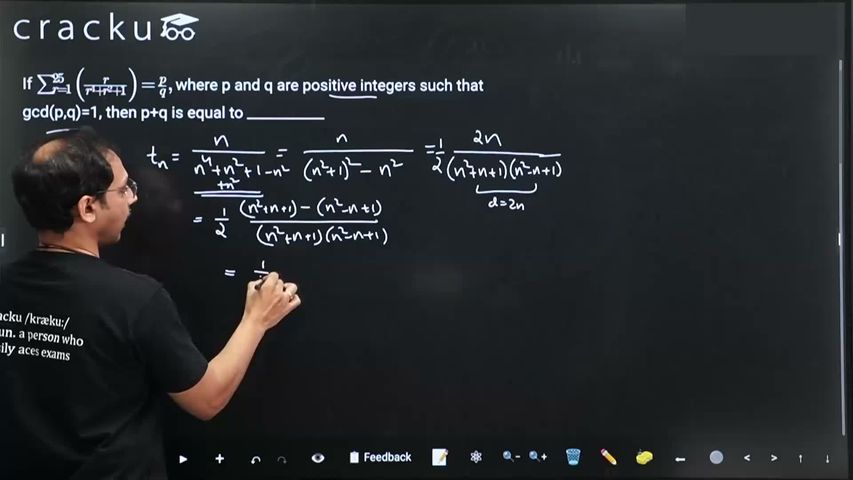
If $$\sum_{r=1}^{25}\left( \frac{r}{r^{4}+r^{2}+1} \right)=\frac{p}{q},$$ where p and q are positive integers such that gcd(p,q)=1, then p+q is equal to ___________
Correct Answer: 976
To solve the summation problem, we first need to simplify the general term of the series. Let the general term be $$T_r$$.
$$T_r = \frac{r}{r^4 + r^2 + 1}$$
Step 1: Factor the denominator
We can rewrite the denominator by adding and subtracting $$r^2$$:
$$r^4 + r^2 + 1 = (r^4 + 2r^2 + 1) - r^2$$ $$r^4 + r^2 + 1 = (r^2 + 1)^2 - r^2$$
Using the difference of squares formula, $$a^2 - b^2 = (a - b)(a + b)$$:
$$r^4 + r^2 + 1 = (r^2 - r + 1)(r^2 + r + 1)$$
So, the general term becomes:
$$T_r = \frac{r}{(r^2 - r + 1)(r^2 + r + 1)}$$
Step 2: Express as partial fractions
Notice that the difference between the two factors in the denominator is:
$$(r^2 + r + 1) - (r^2 - r + 1) = 2r$$
We can multiply the numerator and denominator of $$T_r$$ by $$2$$:
$$T_r = \frac{1}{2} \left[ \frac{2r}{(r^2 - r + 1)(r^2 + r + 1)} \right]$$
Now, substitute $$2r$$ with the difference of the factors:
$$T_r = \frac{1}{2} \left[ \frac{(r^2 + r + 1) - (r^2 - r + 1)}{(r^2 - r + 1)(r^2 + r + 1)} \right]$$
Splitting the fraction, we get a telescoping form:
$$T_r = \frac{1}{2} \left[ \frac{1}{r^2 - r + 1} - \frac{1}{r^2 + r + 1} \right]$$
Step 3: Evaluate the sum
Now we evaluate the sum from $$r = 1$$ to $$r = 25$$:
$$S = \sum_{r=1}^{25} T_r$$
Let's write out the first few terms:
For $$r = 1$$: $$T_1 = \frac{1}{2} \left[ \frac{1}{1} - \frac{1}{3} \right]$$
For $$r = 2$$: $$T_2 = \frac{1}{2} \left[ \frac{1}{3} - \frac{1}{7} \right]$$
For $$r = 3$$: $$T_3 = \frac{1}{2} \left[ \frac{1}{7} - \frac{1}{13} \right]$$
...
For $$r = 25$$: $$T_{25} = \frac{1}{2} \left[ \frac{1}{25^2 - 25 + 1} - \frac{1}{25^2 + 25 + 1} \right]$$
When we add all these terms together, all the intermediate fractions cancel out (telescoping series):
$$S = \frac{1}{2} \left[ 1 - \frac{1}{25^2 + 25 + 1} \right]$$
Calculate the value of the remaining denominator:
$$25^2 + 25 + 1 = 625 + 25 + 1 = 651$$
So, the sum is:
$$S = \frac{1}{2} \left[ 1 - \frac{1}{651} \right]$$ $$S = \frac{1}{2} \left[ \frac{650}{651} \right]$$ $$S = \frac{325}{651}$$
Step 4: Find $$p + q$$
We are given that the sum equals $$\frac{p}{q}$$, where $$\gcd(p, q) = 1$$. Let's check if the fraction $$\frac{325}{651}$$ is in its simplest form.
Since there are no common factors, they are co-prime, meaning $$\gcd(325, 651) = 1$$.
Thus, $$p = 325$$ and $$q = 651$$.
Finally, calculate $$p + q$$:
$$p + q = 325 + 651 = 976$$
The final answer is 976.
$${p}/{q} = \frac{325}{651}$$, and $$p + q = 325 + 651 = 976$$.
Was this solution helpful?
Click on the Email ☝️ to Watch the Video Solution
Create a FREE account and get:
_1.webp)

Educational materials for JEE preparation

Ask our AI anything

AI can make mistakes. Please verify important information.
AI can make mistakes. Please verify important information.
