
Join Our JEE Preparation Group
Prep with like-minded aspirants; Get access to free daily tests and study material.
Sign in
Please select an account to continue using cracku.in
↓ →
Join Our JEE Preparation Group
Prep with like-minded aspirants; Get access to free daily tests and study material.
Given below ar e two statements :
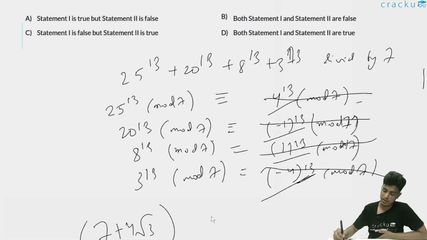
Statement I: $$ 25^{13}+20^{13}+8^{13}+3^{13} $$ is divisible by 7.
Statement II: The integral part of $$(7 + 4\sqrt{3})^{25}$$ is an odd number.
ln the light of the above statements , choose the correct answer from the options given be low :
Statement I: $$25^{13} + 20^{13} + 8^{13} + 3^{13}$$ is divisible by 7.
Using modulo 7:
$$25 \equiv 4 \pmod 7$$
$$20 \equiv 6 \equiv -1 \pmod 7$$
$$8 \equiv 1 \pmod 7$$
$$3 \equiv 3 \pmod 7$$
The expression is $$4^{13} + (-1)^{13} + 1^{13} + 3^{13} \pmod 7 = 4^{13} - 1 + 1 + 3^{13} = 4^{13} + 3^{13} \pmod 7$$.
Since $$4 \equiv -3 \pmod 7$$, then $$4^{13} + 3^{13} \equiv (-3)^{13} + 3^{13} = 0 \pmod 7$$.
Statement I is True.
Statement II: The integral part of $$(7 + 4\sqrt{3})^{25}$$ is odd.
Let $$I + f = (7 + 4\sqrt{3})^{25}$$ and $$f' = (7 - 4\sqrt{3})^{25}$$.
Since $$0 < 7 - 4\sqrt{3} < 1$$, then $$0 < f' < 1$$.
$$(7 + 4\sqrt{3})^{25} + (7 - 4\sqrt{3})^{25} = 2 [ ^{25}C_0 7^{25} + ^{25}C_2 7^{23}(4\sqrt{3})^2 + \dots ] = \text{Even Integer}$$.
$$I + f + f' = \text{Even}$$. Since $$f + f' = 1$$ (to make it an integer), $$I + 1 = \text{Even}$$.
$$I$$ must be Odd.
Statement II is True.
Final Answer: Both Statement I and Statement II are true (Option D).
Was this solution helpful?
Click on the Email ☝️ to Watch the Video Solution
Create a FREE account and get:
_1.webp)

Educational materials for JEE preparation

Ask our AI anything

AI can make mistakes. Please verify important information.
AI can make mistakes. Please verify important information.
