
Join Our JEE Preparation Group
Prep with like-minded aspirants; Get access to free daily tests and study material.
Sign in
Please select an account to continue using cracku.in
↓ →
Join Our JEE Preparation Group
Prep with like-minded aspirants; Get access to free daily tests and study material.
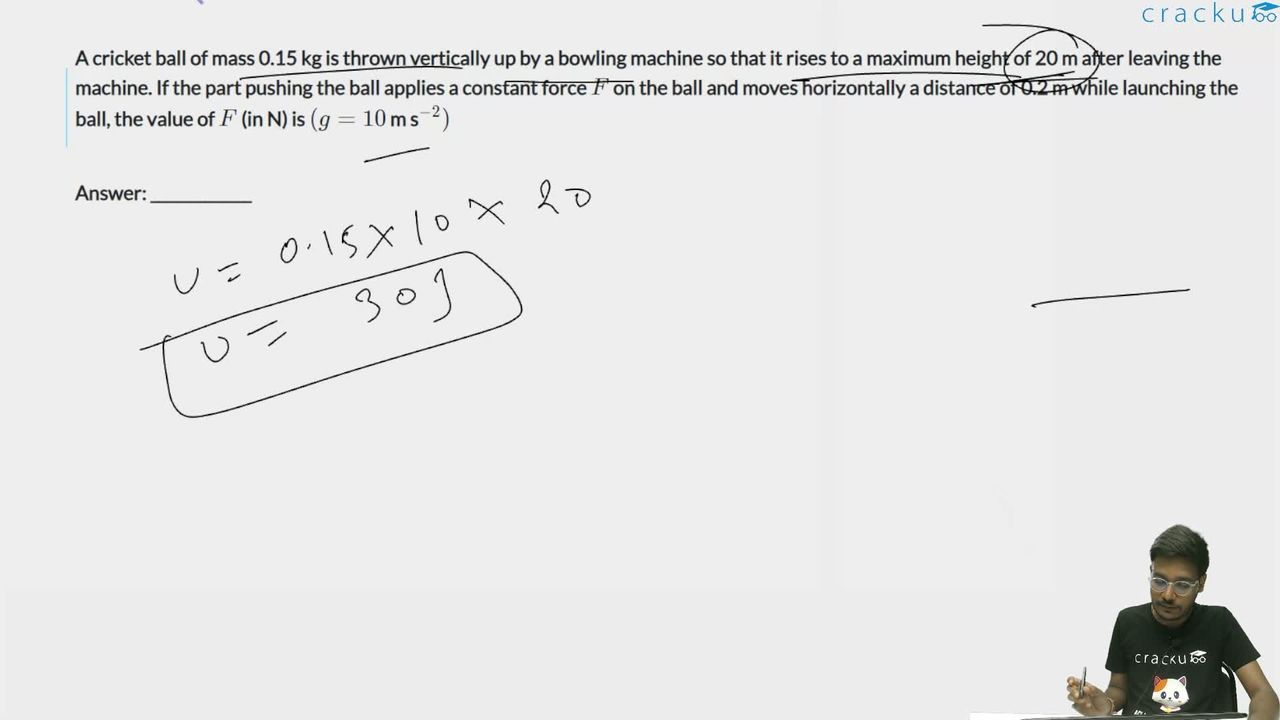
A cricket ball of mass 0.15 kg is thrown vertically up by a bowling machine so that it rises to a maximum height of 20 m after leaving the machine. If the part pushing the ball applies a constant force $$F$$ on the ball and moves horizontally a distance of 0.2 m while launching the ball, the value of $$F$$ (in N) is $$(g = 10$$ m s$$^{-2})$$
Correct Answer: 150
The mass of the cricket ball is given as $$m = 0.15 \text{ kg}$$ and the ball finally rises to a maximum height of $$h = 20 \text{ m}$$ after leaving the machine. We first find the speed with which the ball must leave the machine.
According to the principle of conservation of mechanical energy, the kinetic energy with which the ball leaves the machine is completely converted into gravitational potential energy at the highest point. Writing this idea mathematically, we state the formulae:
Potential energy at height $$h$$: $$U = mgh$$
Kinetic energy at launch: $$K = \dfrac12 m v^2$$
Since all of the kinetic energy changes into potential energy, we have
$$\dfrac12 m v^2 = m g h.$$
Dividing both sides by $$m$$ (because $$m \neq 0$$) gives
$$\dfrac12 v^2 = g h.$$
Multiplying both sides by $$2$$, we obtain
$$v^2 = 2 g h.$$
Now we substitute the numerical values $$g = 10 \text{ m s}^{-2}$$ and $$h = 20 \text{ m}$$:
$$v^2 = 2 \times 10 \times 20 = 400.$$
Taking the square root, we get the speed at launch:
$$v = \sqrt{400} = 20 \text{ m s}^{-1}.$$
Next, we relate this speed to the force that the bowling machine exerts. While the ball is in contact with the machine, it travels a distance $$s = 0.2 \text{ m}$$ under the action of a constant force $$F$$. The work-energy theorem tells us that the work done by this force equals the change in kinetic energy of the ball:
Work done by the force: $$W = F s.$$
Change in kinetic energy (initially the ball is at rest): $$\Delta K = \dfrac12 m v^2 - 0.$$
Equating the two, we write
$$F s = \dfrac12 m v^2.$$
Solving for $$F$$, we have
$$F = \dfrac{\dfrac12 m v^2}{s}.$$
Substituting $$m = 0.15 \text{ kg}$$, $$v = 20 \text{ m s}^{-1}$$, and $$s = 0.2 \text{ m}$$, we get
$$F = \dfrac{\dfrac12 \times 0.15 \times (20)^2}{0.2}.$$
First compute the numerator:
$$\dfrac12 \times 0.15 = 0.075,$$ $$0.075 \times (20)^2 = 0.075 \times 400 = 30.$$
Now divide by the distance $$s$$:
$$F = \dfrac{30}{0.2} = 150 \text{ N}.$$
So, the answer is $$150$$.
Was this solution helpful?
Click on the Email ☝️ to Watch the Video Solution
Create a FREE account and get:
_1.webp)

Educational materials for JEE preparation

Ask our AI anything

AI can make mistakes. Please verify important information.
AI can make mistakes. Please verify important information.
