
Join Our JEE Preparation Group
Prep with like-minded aspirants; Get access to free daily tests and study material.
Sign in
Please select an account to continue using cracku.in
↓ →
Join Our JEE Preparation Group
Prep with like-minded aspirants; Get access to free daily tests and study material.
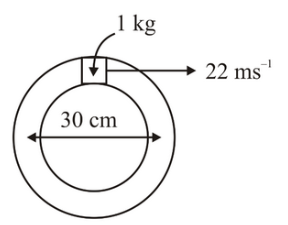
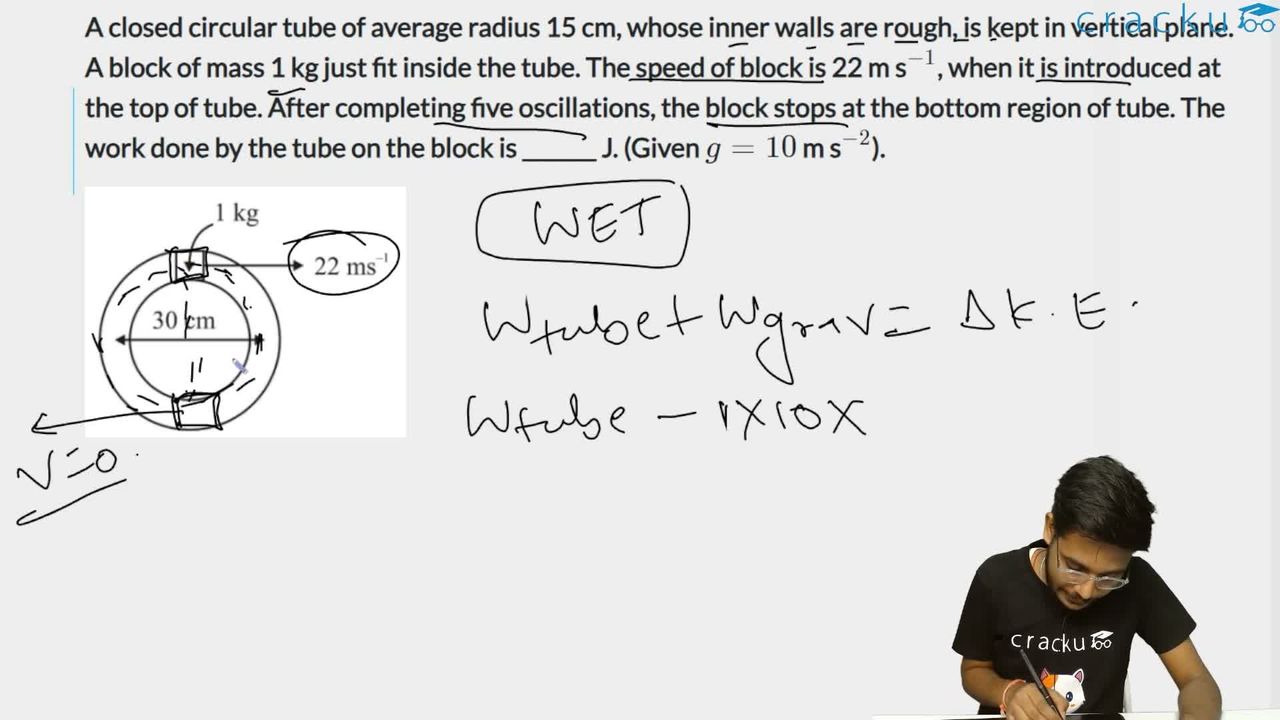
A closed circular tube of average radius 15 cm, whose inner walls are rough, is kept in vertical plane. A block of mass 1 kg just fit inside the tube. The speed of block is 22 m s$$^{-1}$$, when it is introduced at the top of tube. After completing five oscillations, the block stops at the bottom region of tube. The work done by the tube on the block is _______ J. (Given $$g = 10$$ m s$$^{-2}$$).
Correct Answer: 245
The tube is a vertical circle of radius $$R = 15 \text{ cm} = 0.15 \text{ m}$$. Take the bottom‐most point of the circle as the reference level of gravitational potential energy (GPE).
Initial (block released at the top)
Height of the top above the bottom is the diameter, $$h = 2R = 0.30 \text{ m}$$.
Initial speed is $$v_0 = 22 \text{ m s}^{-1}$$.
Initial kinetic energy $$K_i = \tfrac12 m v_0^{2} = \tfrac12 (1) (22)^{2} = \tfrac12 (484) = 242 \text{ J}$$.
Initial gravitational potential energy $$U_i = mgh = (1)(10)(0.30) = 3 \text{ J}$$.
Hence the initial total mechanical energy $$E_i = K_i + U_i = 242 + 3 = 245 \text{ J}$$.
Final (block finally comes to rest at the bottom)
Final speed $$v_f = 0$$, so $$K_f = 0$$.
At the bottom, $$U_f = 0$$ by our choice of reference.
Therefore the final mechanical energy $$E_f = 0 + 0 = 0 \text{ J}$$.
Work done by the tube (friction)
For non-conservative forces,
$$W_{\text{tube}} = E_f - E_i$$.
Substituting, $$W_{\text{tube}} = 0 - 245 = -245 \text{ J}$$.
The negative sign shows that the tube removes energy from the block. Thus the magnitude of the work done by the tube on the block is $$245 \text{ J}$$.
Answer: $$245 \text{ J}$$.
Click on the Email ☝️ to Watch the Video Solution
Create a FREE account and get:
_1.webp)

Educational materials for JEE preparation

Ask our AI anything

AI can make mistakes. Please verify important information.
AI can make mistakes. Please verify important information.


