
Join Our JEE Preparation Group
Prep with like-minded aspirants; Get access to free daily tests and study material.
Sign in
Please select an account to continue using cracku.in
↓ →
Join Our JEE Preparation Group
Prep with like-minded aspirants; Get access to free daily tests and study material.
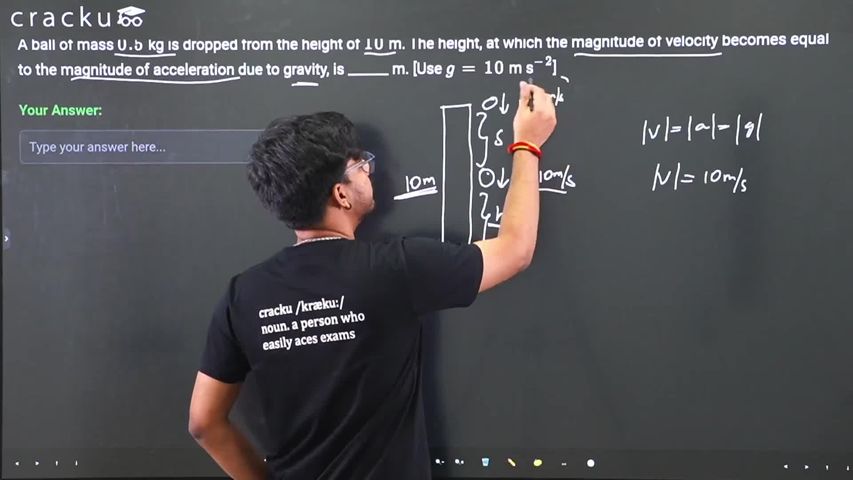
A ball of mass $$0.5$$ kg is dropped from the height of $$10$$ m. The height, at which the magnitude of velocity becomes equal to the magnitude of acceleration due to gravity, is ______ m. [Use $$g = 10$$ m s$$^{-2}$$]
Correct Answer: 5
A ball of mass 0.5 kg is dropped from a height of 10 m. We need to find the height at which the magnitude of velocity equals the magnitude of acceleration due to gravity ($$g = 10$$ m/s$$^2$$).
The condition to be satisfied is $$|v| = |g| = 10$$ m/s, which means we compare the numerical value of the velocity with the numerical value of $$g$$ (i.e., $$v = 10$$ m/s).
For a ball dropped from rest (initial velocity $$u = 0$$) and falling a distance $$s$$, the kinematic equation $$v^2 = u^2 + 2gs$$ applies. Substituting $$u = 0$$ and $$g = 10$$ into this equation gives $$v^2 = 20s$$.
Substituting $$v = 10$$ m/s into the relation $$v^2 = 20s$$ yields $$(10)^2 = 20s$$, so $$100 = 20s$$ and hence $$s = 5$$ m.
Since the ball was dropped from a height of 10 m, the height above the ground at this point is $$h = 10 - s = 10 - 5 = 5$$ m.
Therefore, the height at which the magnitude of velocity equals the magnitude of acceleration due to gravity is 5 m.
Was this solution helpful?
Click on the Email ☝️ to Watch the Video Solution
Create a FREE account and get:
_1.webp)

Educational materials for JEE preparation

Ask our AI anything

AI can make mistakes. Please verify important information.
AI can make mistakes. Please verify important information.
