
Join Our JEE Preparation Group
Prep with like-minded aspirants; Get access to free daily tests and study material.
Sign in
Please select an account to continue using cracku.in
↓ →
Join Our JEE Preparation Group
Prep with like-minded aspirants; Get access to free daily tests and study material.
Let the mean and the standard deviation of the observation 2, 3, 3, 4, 5, 7, a, b be 4 and $$\sqrt{2}$$ respectively. Then the mean deviation about the mode of these observations is :
Let the eight observations be $$2,\,3,\,3,\,4,\,5,\,7,\,a,\,b$$.
Given mean $$\bar{x}=4$$.
For $$n=8$$ observations, the sum satisfies
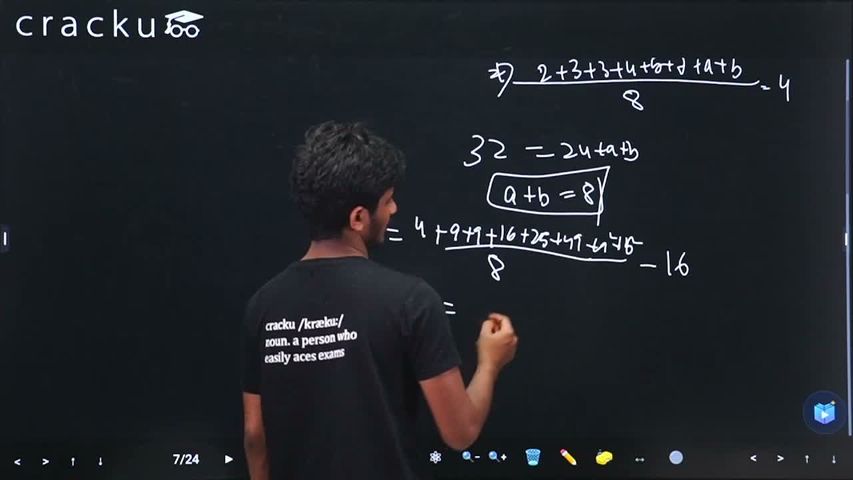
$$2+3+3+4+5+7+a+b = 8\times 4 = 32$$
$$24 + a + b = 32 \;\;\Longrightarrow\;\; a + b = 8$$ $$-(1)$$
The standard deviation is $$\sqrt{2}$$, so the variance is $$2$$.
Variance formula: for $$n$$ observations,
$$\sigma^2=\dfrac{1}{n}\sum_{i=1}^{n}(x_i-\bar{x})^2$$ $$-(2)$$
Compute the squared deviations of the known numbers from $$\bar{x}=4$$:
$$(2-4)^2=4,\;(3-4)^2=1,\;(3-4)^2=1,\;(4-4)^2=0,\;(5-4)^2=1,\;(7-4)^2=9$$
Sum of these six values $$=4+1+1+0+1+9=16$$.
Include the unknowns: Total squared deviation $$=16 + (a-4)^2 + (b-4)^2$$.
Using $$\sigma^2=2$$ and $$n=8$$ in $$(2)$$: $$\dfrac{16 + (a-4)^2 + (b-4)^2}{8}=2$$ $$16 + (a-4)^2 + (b-4)^2 =16$$ $$(a-4)^2 + (b-4)^2 =0$$.
Since a square is non-negative, both must be zero: $$a-4=0,\;b-4=0\;\;\Longrightarrow\;\; a=4,\;b=4$$.
The complete data set is $$2,\,3,\,3,\,4,\,4,\,4,\,5,\,7$$.
Mode: the value that occurs most often is $$4$$ (three times).
Mean deviation about the mode (M.D.) is $$\text{M.D.}=\dfrac{1}{n}\sum_{i=1}^{n}\lvert x_i - \text{mode}\rvert.$$
Compute the absolute deviations from $$4$$: $$|2-4|=2,\;|3-4|=1,\;|3-4|=1,\;|4-4|=0,\;|4-4|=0,\;|4-4|=0,\;|5-4|=1,\;|7-4|=3$$ Sum $$=2+1+1+0+0+0+1+3=8$$.
Therefore $$\text{M.D.}=\dfrac{8}{8}=1$$.
Hence, the mean deviation about the mode is $$1$$ (Option A).
Was this solution helpful?
Click on the Email ☝️ to Watch the Video Solution
Create a FREE account and get:
_1.webp)

Educational materials for JEE preparation

Ask our AI anything

AI can make mistakes. Please verify important information.
AI can make mistakes. Please verify important information.
