
Join Our JEE Preparation Group
Prep with like-minded aspirants; Get access to free daily tests and study material.
Sign in
Please select an account to continue using cracku.in
↓ →
Join Our JEE Preparation Group
Prep with like-minded aspirants; Get access to free daily tests and study material.
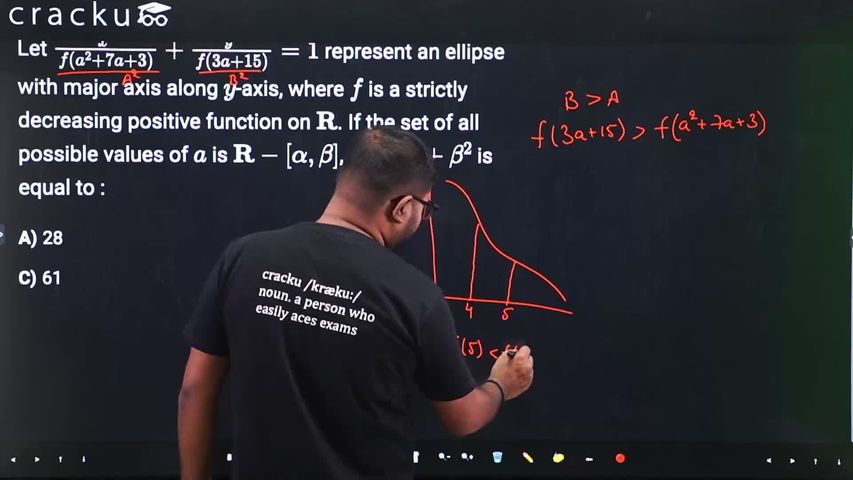
Let $$\frac{x^2}{f(a^2+7a+3)} + \frac{y^2}{f(3a+15)} = 1$$ represent an ellipse with major axis along $$y$$-axis, where $$f$$ is a strictly decreasing positive function on $$\mathbf{R}$$. If the set of all possible values of $$a$$ is $$\mathbf{R} - [\alpha, \beta]$$, then $$\alpha^2 + \beta^2$$ is equal to :
This problem is a clever mix of coordinate geometry and functional properties. Here is the step-by-step breakdown.
1. Identify the Ellipse Condition
For the equation $$\frac{x^2}{A} + \frac{y^2}{B} = 1$$ to be an ellipse with its major axis along the $$y$$-axis, the denominator of the $$y^2$$ term must be greater than the denominator of the $$x^2$$ term ($$B > A$$).
From the image, we have:
So, the condition is:
$$f(3a + 15) > f(a^2 + 7a + 3)$$
2. Apply the Function Property
The problem states that $$f$$ is a strictly decreasing function.
Applying this property to our inequality:
$$3a + 15 < a^2 + 7a + 3$$
3. Solve the Quadratic Inequality
Rearrange the terms to one side:
$$0 < a^2 + 7a - 3a + 3 - 15$$
$$a^2 + 4a - 12 > 0$$
Factor the quadratic:
$$(a + 6)(a - 2) > 0$$
The roots are $$a = -6$$ and $$a = 2$$. For the expression to be greater than zero, $$a$$ must lie outside the roots:
$$a \in (-\infty, -6) \cup (2, \infty)$$
4. Determine $$\alpha$$ and $$\beta$$
The problem defines the set of values as $$\mathbb{R} - [\alpha, \beta]$$.
Our result $$(-\infty, -6) \cup (2, \infty)$$ is equivalent to:
$$\mathbb{R} - [-6, 2]$$
By comparison:
5. Final Calculation
The question asks for the value of $$\alpha^2 + \beta^2$$:
$$\alpha^2 + \beta^2 = (-6)^2 + (2)^2$$
$$36 + 4 = \mathbf{40}$$
Correct Option: B (40)
Was this solution helpful?
Click on the Email ☝️ to Watch the Video Solution
Create a FREE account and get:
_1.webp)

Educational materials for JEE preparation

Ask our AI anything

AI can make mistakes. Please verify important information.
AI can make mistakes. Please verify important information.
