
Join Our JEE Preparation Group
Prep with like-minded aspirants; Get access to free daily tests and study material.
Sign in
Please select an account to continue using cracku.in
↓ →
Join Our JEE Preparation Group
Prep with like-minded aspirants; Get access to free daily tests and study material.
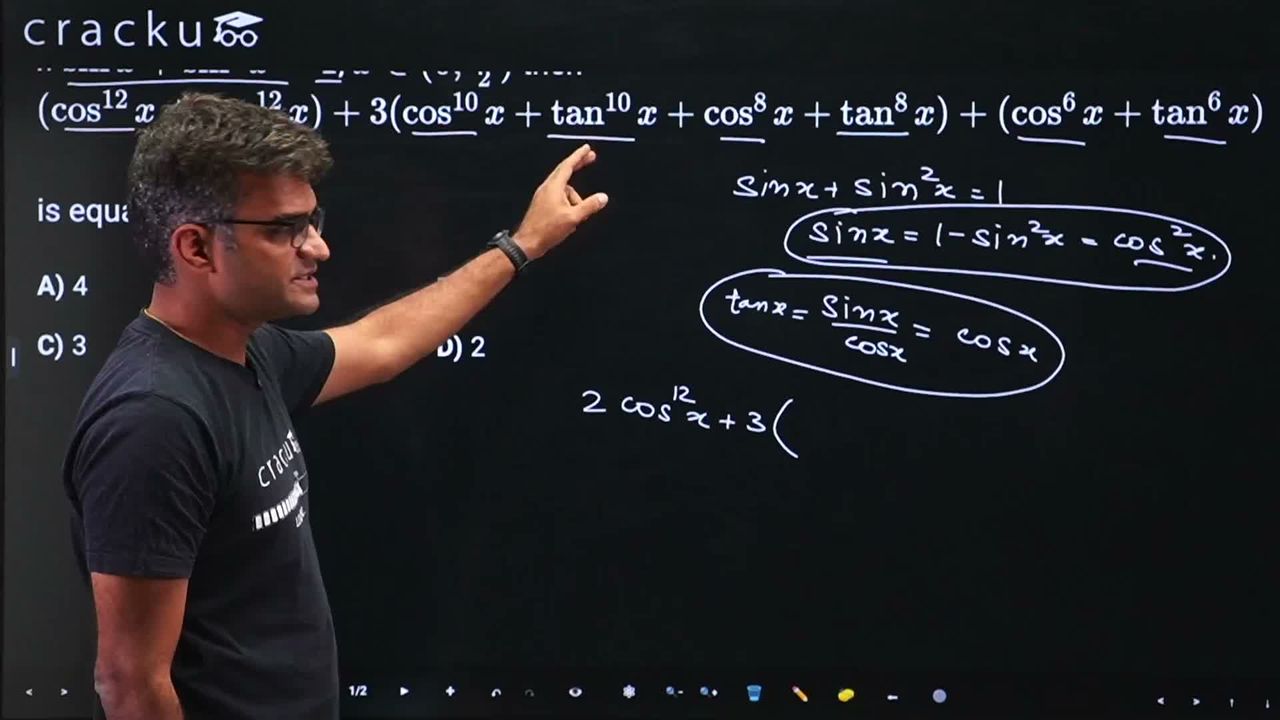
If $$\sin x + \sin^2 x = 1$$, $$x \in (0, \tfrac{\pi}{2})$$ then $$(\cos^{12}x+\tan^{12}x)+3(\cos^{10}x+\tan^{10}x+\cos^{8}x+\tan^{8} x)+(\cos^{6}x+\tan^{6}x)$$
is equal to :
Step 1: Simplify the given trigonometric condition
Given the equation:
$$\sin x + \sin^2 x = 1$$
We know the fundamental trigonometric identity:
$$\sin^2 x + \cos^2 x = 1$$
By comparing these two equations, we can deduce:
$$\sin x = \cos^2 x$$
Step 2: Establish a relationship between tangent and cosine
Using the fundamental definition of the tangent function:
$$\tan x = \frac{\sin x}{\cos x}$$
Substitute $$\sin x = \cos^2 x$$ into the numerator:
$$\tan x = \frac{\cos^2 x}{\cos x}$$
$$\tan x = \cos x$$
This implies that for any integer power $$k$$:
$$\tan^k x = \cos^k x$$
Step 3: Substitute and simplify the main expression
The expression we need to evaluate is:
$$(\cos^{12} x + \tan^{12} x) + 3(\cos^{10} x + \tan^{10} x + \cos^8 x + \tan^8 x) + (\cos^6 x + \tan^6 x)$$
Replace all $$\tan^k x$$ terms with $$\cos^k x$$:
$$(\cos^{12} x + \cos^{12} x) + 3(\cos^{10} x + \cos^{10} x + \cos^8 x + \cos^8 x) + (\cos^6 x + \cos^6 x)$$
Combine the like terms:
$$2\cos^{12} x + 3(2\cos^{10} x + 2\cos^8 x) + 2\cos^6 x$$
$$2\cos^{12} x + 6\cos^{10} x + 6\cos^8 x + 2\cos^6 x$$
Factor out the common multiplier $$2$$:
$$2(\cos^{12} x + 3\cos^{10} x + 3\cos^8 x + \cos^6 x)$$
Step 4: Condense the algebraic expression
Notice that the terms inside the parentheses form a perfect cube algebraic expansion, which resembles the standard identity $$(a + b)^3 = a^3 + 3a^2b + 3ab^2 + b^3$$.
Let $$a = \cos^4 x$$ and $$b = \cos^2 x$$. We can verify this setup:
Since all terms match perfectly, the expression condenses to:
$$2(\cos^4 x + \cos^2 x)^3$$
Step 5: Final substitution and evaluation
From Step 1, we established $$\cos^2 x = \sin x$$. Squaring both sides yields $$\cos^4 x = \sin^2 x$$.
Substitute these values back into our condensed expression:
$$2(\sin^2 x + \sin x)^3$$
Since the original problem states $$\sin x + \sin^2 x = 1$$, we can substitute $$1$$ into the parenthesis:
$$2(1)^3 = 2(1) = 2$$
Final Answer
The value of the given expression is $$2$$.
Was this solution helpful?
Click on the Email ☝️ to Watch the Video Solution
Create a FREE account and get:
_1.webp)

Educational materials for JEE preparation

Ask our AI anything

AI can make mistakes. Please verify important information.
AI can make mistakes. Please verify important information.
