
Join Our JEE Preparation Group
Prep with like-minded aspirants; Get access to free daily tests and study material.
Sign in
Please select an account to continue using cracku.in
↓ →
Join Our JEE Preparation Group
Prep with like-minded aspirants; Get access to free daily tests and study material.
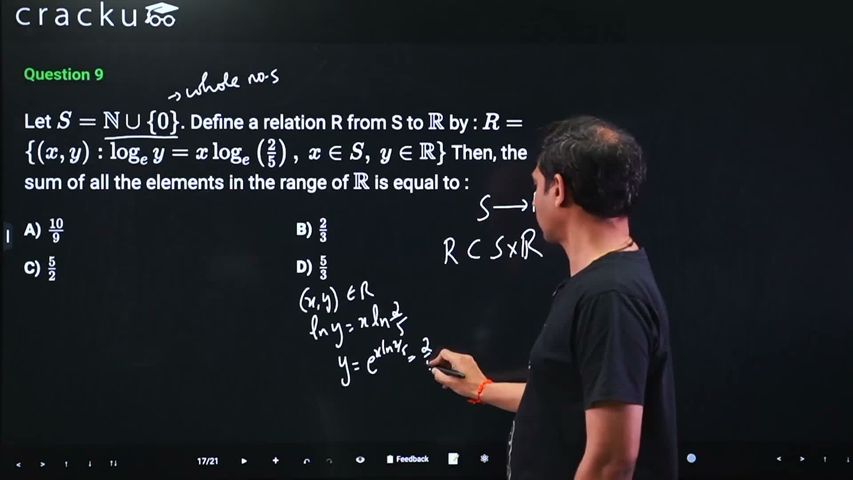
Let $$S = \mathbb{N} \cup \{0\}$$. Define a relation R from S to $$\mathbb{R}$$ by : $$R = \{(x,y) : \log_{e} y = x \log_e\left(\frac{2}{5}\right),\ x \in S,\ y \in \mathbb{R}\}$$ Then, the sum of all the elements in the range of $$\mathbb{R}$$ is equal to :
The relation is $$R = \{(x, y) : \ln y = x \ln(2/5), x \in S = \mathbb{N} \cup \{0\}, y \in \mathbb{R}\}$$.
From $$\ln y = x \ln(2/5)$$, we get $$y = e^{x\ln(2/5)} = (2/5)^x$$.
The range of R is the set of all $$y$$ values: $$\{(2/5)^x : x \in \{0, 1, 2, 3, ...\}\}$$
$$= \{1, 2/5, 4/25, 8/125, ...\}$$
This is an infinite geometric series with first term $$a = 1$$ and common ratio $$r = 2/5$$:
$$ \text{Sum} = \frac{1}{1 - 2/5} = \frac{1}{3/5} = \frac{5}{3} $$
The correct answer is Option 4: $$\frac{5}{3}$$.
Was this solution helpful?
Click on the Email ☝️ to Watch the Video Solution
Create a FREE account and get:
_1.webp)

Educational materials for JEE preparation

Ask our AI anything

AI can make mistakes. Please verify important information.
AI can make mistakes. Please verify important information.
