
Join Our JEE Preparation Group
Prep with like-minded aspirants; Get access to free daily tests and study material.
Sign in
Please select an account to continue using cracku.in
↓ →
Join Our JEE Preparation Group
Prep with like-minded aspirants; Get access to free daily tests and study material.
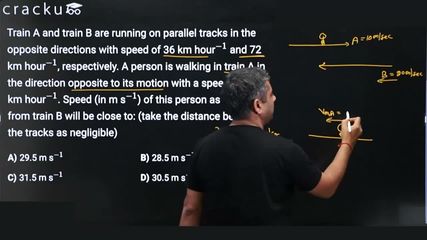
Train A and train B are running on parallel tracks in the opposite directions with speed of 36 km hour$$^{-1}$$ and 72 km hour$$^{-1}$$, respectively. A person is walking in train A in the direction opposite to its motion with a speed of 1.8 km hour$$^{-1}$$. Speed (in m s$$^{-1}$$) of this person as observed from train B will be close to: (take the distance between the tracks as negligible)
Let us choose the direction in which train A is moving as the positive direction.
Speed of train A with respect to the ground is given as $$+36\text{ km h}^{-1}.$$
The person is walking inside train A opposite to the motion of the train. Therefore, the speed of the person with respect to train A is
$$v_{\text{person, A}} = -1.8\text{ km h}^{-1}.$$
To find the speed of the person with respect to the ground, we use the relation
$$v_{\text{person, ground}} = v_{\text{train A, ground}} + v_{\text{person, A}}.$$
Substituting the known values, we obtain
$$v_{\text{person, ground}} = 36 + (-1.8) = 34.2\text{ km h}^{-1}.$$
Now, train B is moving in the opposite direction (negative direction) with speed
$$v_{\text{train B, ground}} = -72\text{ km h}^{-1}.$$
The relative speed of the person as observed from train B is given by the standard formula
$$v_{\text{person relative to B}} = v_{\text{person, ground}} - v_{\text{train B, ground}}.$$
Substituting the values, we have
$$v_{\text{person relative to B}} = 34.2 - (-72) = 34.2 + 72 = 106.2\text{ km h}^{-1}.$$
We must now convert this speed from kilometres per hour to metres per second using
$$1\text{ km h}^{-1} = \frac{5}{18}\text{ m s}^{-1}.$$
Hence,
$$v_{\text{person relative to B}} = 106.2 \times \frac{5}{18}\text{ m s}^{-1}.$$
First multiply:
$$106.2 \times 5 = 531.0.$$
Now divide by 18:
$$\frac{531.0}{18} = 29.5\text{ m s}^{-1}.$$
Therefore, the speed of the person as observed from train B is approximately $$29.5\text{ m s}^{-1}.$$
Hence, the correct answer is Option A.
Was this solution helpful?
Click on the Email ☝️ to Watch the Video Solution
Create a FREE account and get:
_1.webp)

Educational materials for JEE preparation

Ask our AI anything

AI can make mistakes. Please verify important information.
AI can make mistakes. Please verify important information.
