
Join Our JEE Preparation Group
Prep with like-minded aspirants; Get access to free daily tests and study material.
Sign in
Please select an account to continue using cracku.in
↓ →
Join Our JEE Preparation Group
Prep with like-minded aspirants; Get access to free daily tests and study material.
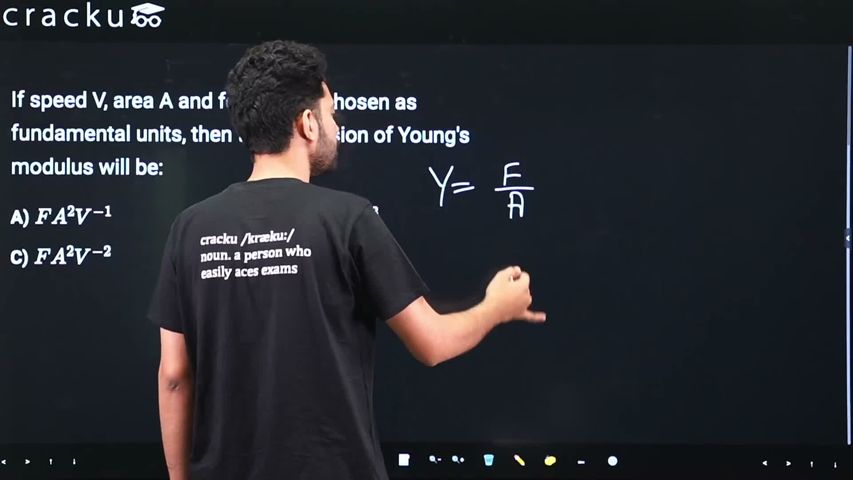
If speed V, area A and force F are chosen as fundamental units, then the dimension of Young's modulus will be:
We know that Young’s modulus $$Y$$ is defined as the ratio of stress to strain. Because strain is a pure number (dimensionless), the dimension of $$Y$$ is the same as the dimension of stress.
First, let us recall that stress is force per unit area, so
$$\text{Stress}=\dfrac{\text{Force}}{\text{Area}}.$$
In the ordinary $$M\!L\!T$$ (mass-length-time) system the dimensional formula of force is $$M\,L\,T^{-2},$$ while the dimensional formula of area is $$L^{2}.$$ Therefore, the dimensional formula of Young’s modulus in the $$M\!L\!T$$ system becomes
$$[Y]=\dfrac{M\,L\,T^{-2}}{L^{2}}=M\,L^{-1}\,T^{-2}.$$
Now the question asks us to re-express this same quantity using a new set of fundamental units: speed $$V,$$ area $$A$$ and force $$F.$$ We write the unknown dimensional formula as
$$[Y]=F^{\,a}\,A^{\,b}\,V^{\,c},$$
where $$a,\,b,\,c$$ are the exponents we must determine.
Next we translate each new fundamental unit back into the familiar $$M\!L\!T$$ language:
$$[F]=M\,L\,T^{-2},\qquad [A]=L^{2},\qquad [V]=L\,T^{-1}.$$
Substituting these into $$F^{\,a}\,A^{\,b}\,V^{\,c}$$ gives
$$F^{\,a}\,A^{\,b}\,V^{\,c}=\left(M\,L\,T^{-2}\right)^{a}\left(L^{2}\right)^{b}\left(L\,T^{-1}\right)^{c}=M^{a}\,L^{\,a+2b+c}\,T^{-2a-c}.$$
This result must match the already known $$M\!L\!T$$ exponents of Young’s modulus, namely $$M^{1}\,L^{-1}\,T^{-2}.$$ Hence we equate exponents term by term:
Mass exponent: $$a=1.$$(1)
Length exponent: $$a+2b+c=-1.$$(2)
Time exponent: $$-2a-c=-2.$$(3)
Using equation (1) $$a=1$$ inside equation (3) gives
$$-2(1)-c=-2\;\;\Longrightarrow\;\;-2-c=-2\;\;\Longrightarrow\;\;c=0.$$
With $$a=1$$ and $$c=0,$$ substitute into equation (2):
$$1+2b+0=-1\;\;\Longrightarrow\;\;2b=-2\;\;\Longrightarrow\;\;b=-1.$$
Thus we have determined
$$a=1,\qquad b=-1,\qquad c=0.$$
Putting these values back, the dimensional formula of Young’s modulus in the $$F\!A\!V$$ system is
$$[Y]=F^{1}\,A^{-1}\,V^{0}=F\,A^{-1}.$$
This matches option D, which is written as $$FA^{-1}V^{0}.$$
Hence, the correct answer is Option D.
Click on the Email ☝️ to Watch the Video Solution
Create a FREE account and get:
_1.webp)

Educational materials for JEE preparation

Ask our AI anything

AI can make mistakes. Please verify important information.
AI can make mistakes. Please verify important information.


