
Join Our JEE Preparation Group
Prep with like-minded aspirants; Get access to free daily tests and study material.
Sign in
Please select an account to continue using cracku.in
↓ →
Join Our JEE Preparation Group
Prep with like-minded aspirants; Get access to free daily tests and study material.
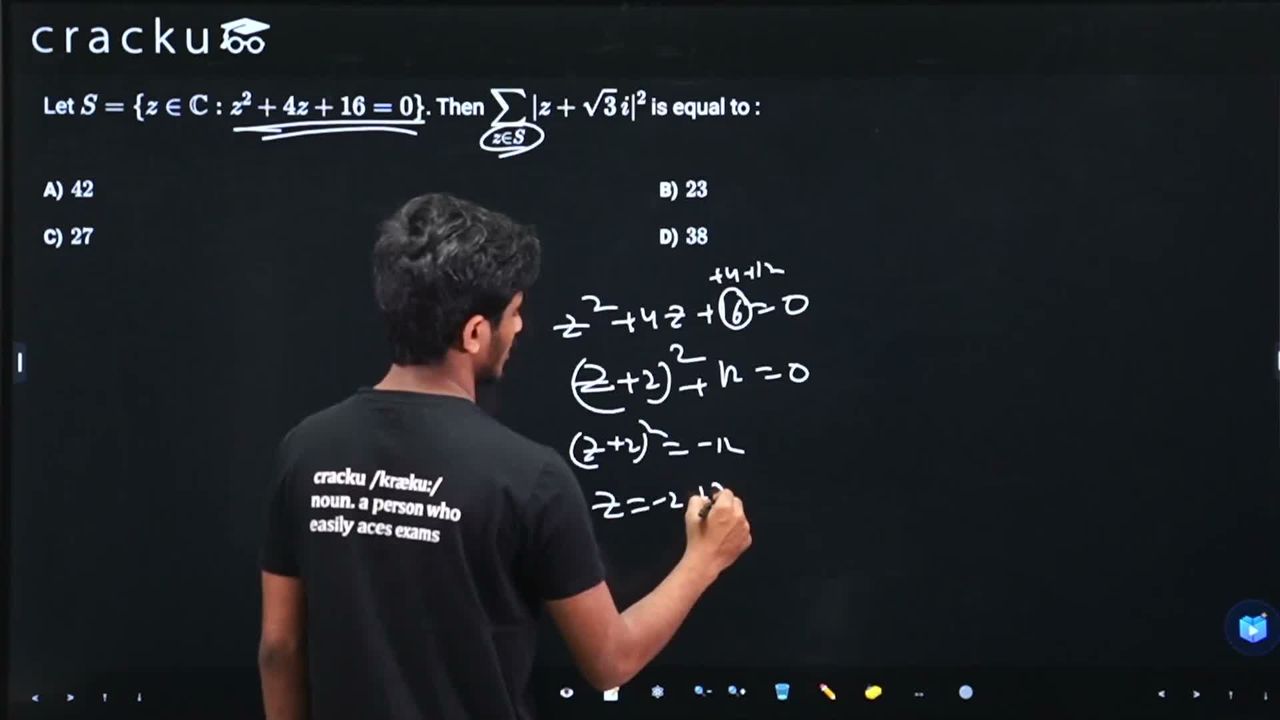
Let $$S = \{z \in \mathbb{C} : z^2 + 4z + 16 = 0\}$$. Then $$\displaystyle\sum_{z \in S} |z + \sqrt{3}\,i|^2$$ is equal to :
For a complex number $$z = x + iy$$, its modulus is $$|z| = \sqrt{x^2 + y^2}$$, so the squared modulus is $$|z|^2 = x^2 + y^2$$.
The roots of $$z^2 + 4z + 16 = 0$$ form the set $$S$$. Solve the quadratic:
Using the quadratic formula, $$z = \dfrac{-4 \pm \sqrt{4^2 - 4 \cdot 1 \cdot 16}}{2} = \dfrac{-4 \pm \sqrt{-48}}{2}$$.
Since $$\sqrt{-48} = i\sqrt{48} = i 4\sqrt{3}$$, the roots are
$$z_1 = -2 + 2\sqrt{3}\,i, \qquad z_2 = -2 - 2\sqrt{3}\,i.$$
For each root, add $$\sqrt{3}\,i$$ and evaluate the squared modulus.
Case 1: $$z = z_1 = -2 + 2\sqrt{3}\,i$$
$$z + \sqrt{3}\,i = -2 + (2\sqrt{3} + \sqrt{3})\,i = -2 + 3\sqrt{3}\,i.$$
Therefore, $$|\,z + \sqrt{3}\,i\,|^2 = (-2)^2 + (3\sqrt{3})^2 = 4 + 9 \cdot 3 = 4 + 27 = 31.$$
Case 2: $$z = z_2 = -2 - 2\sqrt{3}\,i$$
$$z + \sqrt{3}\,i = -2 + (-2\sqrt{3} + \sqrt{3})\,i = -2 - \sqrt{3}\,i.$$
Hence, $$|\,z + \sqrt{3}\,i\,|^2 = (-2)^2 + (-\sqrt{3})^2 = 4 + 3 = 7.$$
Add the two values:
$$\sum_{z \in S} |\,z + \sqrt{3}\,i\,|^2 = 31 + 7 = 38.$$
Option D which is: 38
Was this solution helpful?
Click on the Email ☝️ to Watch the Video Solution
Create a FREE account and get:
_1.webp)

Educational materials for JEE preparation

Ask our AI anything

AI can make mistakes. Please verify important information.
AI can make mistakes. Please verify important information.
