
Join Our JEE Preparation Group
Prep with like-minded aspirants; Get access to free daily tests and study material.
Sign in
Please select an account to continue using cracku.in
↓ →
Join Our JEE Preparation Group
Prep with like-minded aspirants; Get access to free daily tests and study material.
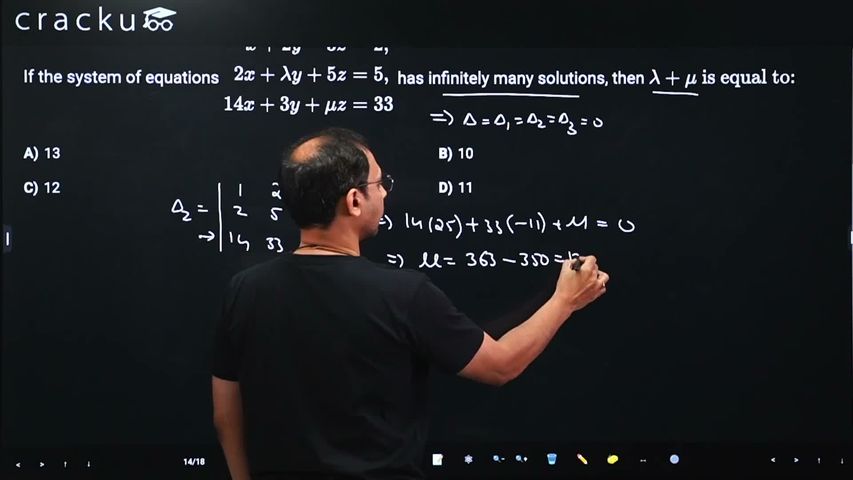
If the system of equations $$\begin{aligned}x + 2y - 3z &= 2, \\2x + \lambda y + 5z &= 5, \\14x + 3y + \mu z &= 33\end{aligned}$$ has infinitely many solutions, then $$\lambda + \mu \text{ is equal to:} $$
For a system of three linear equations to possess infinitely many solutions, the following two conditions must hold:
• The determinant of the coefficient matrix must be zero (so its rank is < 3).
• Every equation must be a linear combination of the others, i.e. the augmented matrix must have the same rank as the coefficient matrix.
Write the coefficient matrix $$A$$ and the constant column $$\mathbf{b}$$:
$$A = \begin{bmatrix}1 & 2 & -3 \\ 2 & \lambda & 5 \\ 14 & 3 & \mu\end{bmatrix},\qquad \mathbf{b} = \begin{bmatrix}2 \\ 5 \\ 33\end{bmatrix}.$$
Step 1 : Determinant of the coefficient matrix
The determinant is
$$\begin{vmatrix}1 & 2 & -3 \\ 2 & \lambda & 5 \\ 14 & 3 & \mu\end{vmatrix} = 1(\lambda\mu-5\!\cdot\!3)\;-\;2(2\mu-5\!\cdot\!14)\;+\;(-3)(2\!\cdot\!3-\lambda\!\cdot\!14).$$
Simplifying term by term:
$$\lambda\mu-15\;-\;2(2\mu-70)\;-\;3(6-14\lambda)$$
$$=\lambda\mu-15\;-\;4\mu+140\;-\,18+42\lambda$$
$$=\mu(\lambda-4)+42\lambda+107.$$
For infinitely many solutions, this determinant must vanish:
$$\mu(\lambda-4)+42\lambda+107=0\quad -(1).$$
Step 2 : Ensuring the third equation is a linear combination of the first two
Assume constants $$a$$ and $$b$$ exist such that
$$a(x+2y-3z)+b(2x+\lambda y+5z)=14x+3y+\mu z \quad\text{and}\quad a(2)+b(5)=33.$$(The left-hand side recreates the third equation’s coefficients and constant term.)
Matching the coefficients of $$x,\,y,\,z$$ and the constants gives
$$\begin{aligned} a+2b &= 14 \quad &(x\text{-coeff})\\ 2a+\lambda b &= 3 \quad &(y\text{-coeff})\\ -3a+5b &= \mu \quad &(z\text{-coeff})\\ 2a+5b &= 33 \quad &(\text{constant}) \end{aligned}$$
From $$a+2b=14$$ obtain
$$a = 14-2b \quad -(2).$$
Substitute $$a$$ from $$(2)$$ into the $$y$$-coefficient condition:
$$2(14-2b)+\lambda b = 3$$
$$28-4b+\lambda b = 3$$
$$(\lambda-4)b = -25$$
$$b = \frac{-25}{\lambda-4} \quad -(3).$$
Insert $$b$$ from $$(3)$$ into the constant condition $$2a+5b=33$$. First compute $$2a$$ using $$(2)$$:
$$2a = 2(14-2b) = 28-4b.$$
Hence
$$28-4b+5b = 33 \;\Longrightarrow\; 28 + b = 33$$
$$b = 5.$$
Equating this value of $$b$$ to the one in $$(3)$$ gives
$$5 = \frac{-25}{\lambda-4}$$
$$\lambda-4 = -5$$
$$\lambda = -1.$$
With $$\lambda=-1$$, use $$(3)$$ to confirm $$b=5$$ and $$(2)$$ to find $$a$$:
$$a = 14 - 2(5) = 4.$$
Finally, compute $$\mu$$ from the $$z$$-coefficient relation:
$$\mu = -3a + 5b = -3(4)+5(5) = -12+25 = 13.$$
Step 3 : Value of $$\lambda+\mu$$
$$\lambda+\mu = (-1)+13 = 12.$$
Therefore, $$\lambda+\mu = 12$$, which corresponds to Option C.
Was this solution helpful?
Click on the Email ☝️ to Watch the Video Solution
Create a FREE account and get:
_1.webp)

Educational materials for JEE preparation

Ask our AI anything

AI can make mistakes. Please verify important information.
AI can make mistakes. Please verify important information.
