
Join Our JEE Preparation Group
Prep with like-minded aspirants; Get access to free daily tests and study material.
Sign in
Please select an account to continue using cracku.in
↓ →
Join Our JEE Preparation Group
Prep with like-minded aspirants; Get access to free daily tests and study material.
Given below are two statements. One is labelled as Assertion A and the other is labelled as Reason R.
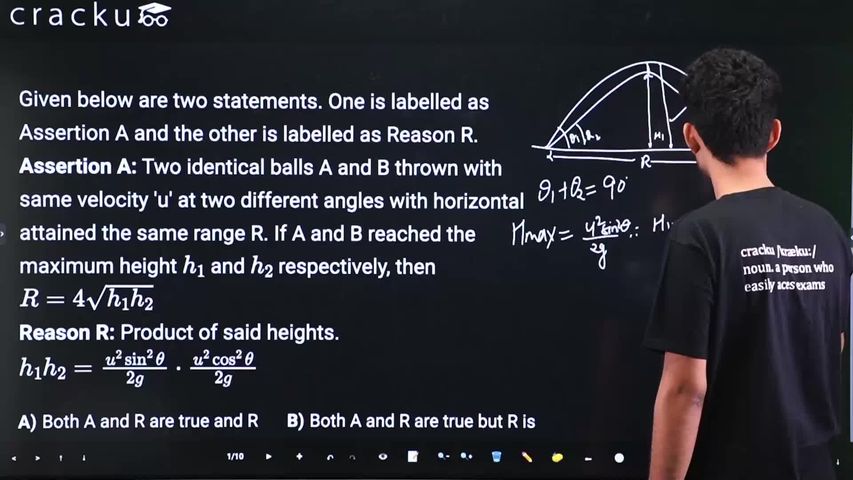
Assertion A: Two identical balls A and B thrown with same velocity 'u' at two different angles with horizontal attained the same range R. If A and B reached the maximum height $$h_1$$ and $$h_2$$ respectively, then $$R = 4\sqrt{h_1 h_2}$$
Reason R: Product of said heights. $$h_1 h_2 = \frac{u^2\sin^2\theta}{2g} \cdot \frac{u^2\cos^2\theta}{2g}$$
For a projectile thrown with velocity $$u$$ at angle $$\theta$$ with the horizontal:
Range: $$R = \frac{u^2 \sin 2\theta}{g}$$
Maximum height: $$h = \frac{u^2 \sin^2\theta}{2g}$$
Two balls A and B achieve the same range. This means if A is thrown at angle $$\theta$$, then B is thrown at angle $$(90° - \theta)$$, since $$\sin 2\theta = \sin 2(90° - \theta)$$.
Maximum heights:
$$h_1 = \frac{u^2 \sin^2\theta}{2g}$$
$$h_2 = \frac{u^2 \cos^2\theta}{2g}$$
Product of heights:
$$h_1 h_2 = \frac{u^2 \sin^2\theta}{2g} \cdot \frac{u^2 \cos^2\theta}{2g} = \frac{u^4 \sin^2\theta \cos^2\theta}{4g^2}$$
So Reason R is true.
Now, $$\sqrt{h_1 h_2} = \frac{u^2 \sin\theta \cos\theta}{2g} = \frac{u^2 \sin 2\theta}{4g}$$
Therefore:
$$4\sqrt{h_1 h_2} = \frac{u^2 \sin 2\theta}{g} = R$$
So Assertion A is also true, and $$R = 4\sqrt{h_1 h_2}$$ follows directly from the product $$h_1 h_2$$ computed in R. Thus R is the correct explanation of A.
Hence, the correct answer is Option A.
Was this solution helpful?
Click on the Email ☝️ to Watch the Video Solution
Create a FREE account and get:
_1.webp)

Educational materials for JEE preparation

Ask our AI anything

AI can make mistakes. Please verify important information.
AI can make mistakes. Please verify important information.


