
Join Our JEE Preparation Group
Prep with like-minded aspirants; Get access to free daily tests and study material.
Sign in
Please select an account to continue using cracku.in
↓ →
Join Our JEE Preparation Group
Prep with like-minded aspirants; Get access to free daily tests and study material.
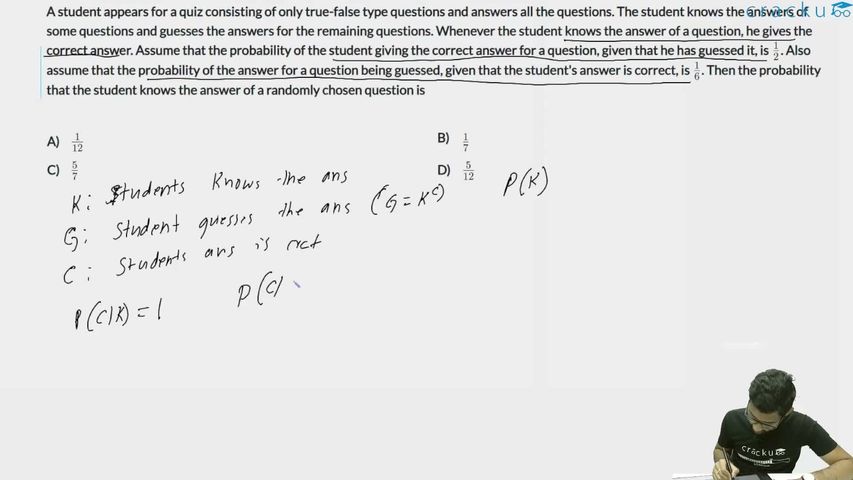
A student appears for a quiz consisting of only true-false type questions and answers all the questions. The student knows the answers of some questions and guesses the answers for the remaining questions. Whenever the student knows the answer of a question, he gives the correct answer. Assume that the probability of the student giving the correct answer for a question, given that he has guessed it, is $$\frac{1}{2}$$. Also assume that the probability of the answer for a question being guessed, given that the student's answer is correct, is $$\frac{1}{6}$$. Then the probability that the student knows the answer of a randomly chosen question is
Let us define three events for a randomly chosen question:
$$K$$ : the student knows the answer.
$$G$$ : the student guesses the answer. (So $$G = K^{\,c}$$)
$$C$$ : the student’s answer is correct.
Given data in probability notation:
$$P(C \mid K)=1$$ (if he knows, he is always correct)
$$P(C \mid G)=\frac12$$ (probability of a correct guess)
$$P(G \mid C)=\frac16$$ (a correct answer is guessed with probability $$\tfrac16$$)
We want $$P(K)$$, the probability that the student knows a randomly chosen question.
Step 1 - Express $$P(G \cap C)$$ in two ways.
By the definition of conditional probability,
$$P(G \mid C)=\frac{P(G \cap C)}{P(C)}$$ $$-(1)$$
But, for the joint event,
$$P(G \cap C)=P(C \mid G)\,P(G)=\frac12\,P(G)$$ $$-(2)$$
Insert $$(2)$$ into $$(1)$$ and use the given value $$P(G \mid C)=\tfrac16$$:
$$\frac12\,P(G) \;=\; \frac16\,P(C)$$
$$\Rightarrow\; P(G)=\frac{1}{3}\,P(C)$$ $$-(3)$$
Step 2 - Write $$P(C)$$ via the law of total probability.
$$P(C)=P(C \mid K)\,P(K)+P(C \mid G)\,P(G)$$
$$\;\;\; = 1\cdot P(K)+\frac12\,P(G)$$
$$\;\;\; = P(K)+\frac12\,P(G)$$ $$-(4)$$
Step 3 - Substitute $$P(G)=\tfrac13 P(C)$$ from $$(3)$$ into $$(4)$$.
$$P(C)=P(K)+\frac12\left(\frac13 P(C)\right)=P(K)+\frac16\,P(C)$$
Rearrange:
$$P(C)-\frac16 P(C)=P(K)$$
$$\frac56\,P(C)=P(K)$$ $$-(5)$$
Step 4 - Use $$P(K)+P(G)=1$$ with $$(3)$$ and $$(5)$$ to find $$P(C)$$.
$$P(K)+P(G)=1$$
$$\frac56\,P(C)+\frac13\,P(C)=1$$
$$\left(\frac56+\frac26\right)P(C)=1$$
$$\frac76\,P(C)=1$$
$$\Rightarrow\; P(C)=\frac67$$
Step 5 - Obtain the required probability $$P(K)$$.
From $$(5)$$:
$$P(K)=\frac56\,P(C)=\frac56\left(\frac67\right)=\frac57$$
Therefore, the probability that the student knows the answer of a randomly chosen question is $$\frac57$$.
Option C which is: $$\frac{5}{7}$$
Was this solution helpful?
Click on the Email ☝️ to Watch the Video Solution
Create a FREE account and get:
_1.webp)

Educational materials for JEE preparation

Ask our AI anything

AI can make mistakes. Please verify important information.
AI can make mistakes. Please verify important information.
