
Join Our JEE Preparation Group
Prep with like-minded aspirants; Get access to free daily tests and study material.
Sign in
Please select an account to continue using cracku.in
↓ →
Join Our JEE Preparation Group
Prep with like-minded aspirants; Get access to free daily tests and study material.
A disc is rolling without slipping on a surface. The radius of the disc is $$R$$. At $$t = 0$$, the top most point on the disc is $$A$$ as shown in figure. When the disc completes half of its rotation, the displacement of point $$A$$ from its initial position is
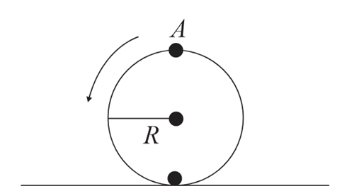
When a disc of radius $$R$$ rolls without slipping, the topmost point $$A$$ traces a cycloid path.
After the disc completes half a rotation, the center of the disc moves a distance equal to half the circumference:
$$d_{center} = \pi R$$
Point $$A$$ starts at the top. After half a rotation, point $$A$$ reaches the bottom of the disc.
The horizontal displacement of point $$A$$: The center moves $$\pi R$$ horizontally, and relative to the center, point $$A$$ moves from top (0, +R) to bottom (0, -R). So the horizontal displacement of $$A$$ equals the horizontal displacement of the center = $$\pi R$$.
The vertical displacement of point $$A$$: Point $$A$$ was at the top (height $$2R$$ from ground), and after half rotation it is at the bottom (height $$0$$ from ground). So vertical displacement = $$2R$$ downward.
The net displacement of point $$A$$:
$$d = \sqrt{(\pi R)^2 + (2R)^2}$$
$$d = R\sqrt{\pi^2 + 4}$$
The displacement of point $$A$$ from its initial position is $$\mathbf{R\sqrt{\pi^2 + 4}}$$.
Was this solution helpful?
Create a FREE account and get:
_1.webp)

Educational materials for JEE preparation

Ask our AI anything

AI can make mistakes. Please verify important information.
AI can make mistakes. Please verify important information.


