
Join Our JEE Preparation Group
Prep with like-minded aspirants; Get access to free daily tests and study material.
Sign in
Please select an account to continue using cracku.in
↓ →
Join Our JEE Preparation Group
Prep with like-minded aspirants; Get access to free daily tests and study material.
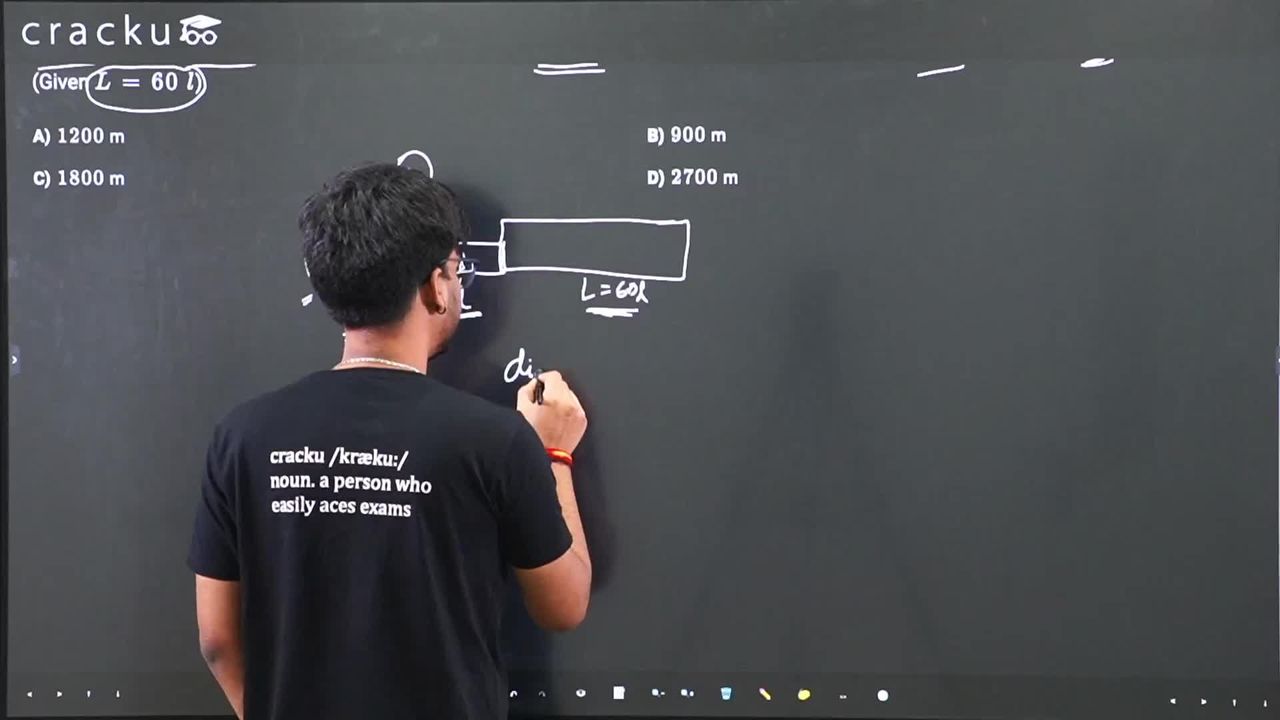
Two trains $$A$$ and $$B$$ of length $$l$$ and $$4l$$ are travelling into a tunnel of length $$L$$ in parallel tracks from opposite directions with velocities $$108$$ km h$$^{-1}$$ and $$72$$ km h$$^{-1}$$, respectively. If train $$A$$ take $$35$$ s less time than train $$B$$ to cross the tunnel then, length $$L$$ of tunnel is:
(Given $$L = 60 \ l$$)
We need to find the length of the tunnel $$L$$ given that train $$A$$ (length $$l$$) takes 35 s less than train $$B$$ (length $$4l$$) to cross the tunnel.
Convert velocities to m/s:
$$v_A = 108 \text{ km/h} = 108 \times \frac{5}{18} = 30 \text{ m/s}$$
$$v_B = 72 \text{ km/h} = 72 \times \frac{5}{18} = 20 \text{ m/s}$$
Time for a train to cross a tunnel = (length of train + length of tunnel) / speed of train.
$$t_A = \frac{L + l}{30}$$
$$t_B = \frac{L + 4l}{20}$$
Given $$t_B - t_A = 35$$ s:
$$\frac{L + 4l}{20} - \frac{L + l}{30} = 35$$
Taking LCM of 20 and 30 = 60:
$$\frac{3(L + 4l) - 2(L + l)}{60} = 35$$
$$\frac{3L + 12l - 2L - 2l}{60} = 35$$
$$\frac{L + 10l}{60} = 35$$
$$L + 10l = 2100$$
Given $$L = 60l$$, so $$l = \frac{L}{60}$$:
$$L + 10 \times \frac{L}{60} = 2100$$
$$L + \frac{L}{6} = 2100$$
$$\frac{7L}{6} = 2100$$
$$L = \frac{2100 \times 6}{7} = 1800 \text{ m}$$
The length of the tunnel is $$\mathbf{1800}$$ m.
Click on the Email ☝️ to Watch the Video Solution
Create a FREE account and get:
_1.webp)

Educational materials for JEE preparation

Ask our AI anything

AI can make mistakes. Please verify important information.
AI can make mistakes. Please verify important information.


