
Join Our JEE Preparation Group
Prep with like-minded aspirants; Get access to free daily tests and study material.
Sign in
Please select an account to continue using cracku.in
↓ →
Join Our JEE Preparation Group
Prep with like-minded aspirants; Get access to free daily tests and study material.
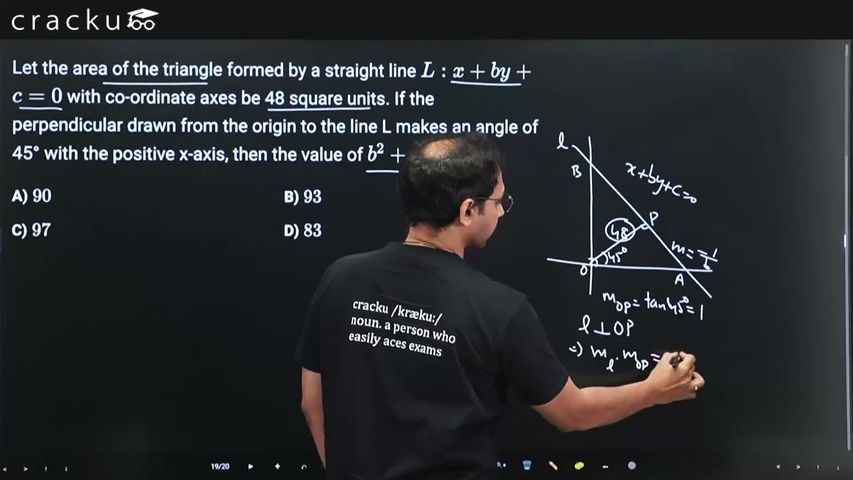
Let the area of the triangle formed by a straight line $$L : x + by + c = 0$$ with co-ordinate axes be 48 square units. If the perpendicular drawn from the origin to the line L makes an angle of 45° with the positive x-axis, then the value of $$b^2 + c^2$$ is :
The line is $$L : x + by + c = 0$$. It cuts the x-axis at $$(-c,\,0)$$ (put $$y = 0$$) and the y-axis at $$(0,\,-\tfrac{c}{b})$$ (put $$x = 0$$).
Formula for the area of the triangle formed with the co-ordinate axes is
$$\text{Area} = \tfrac12 \left|\text{x-intercept}\right| \times \left|\text{y-intercept}\right|.$$
Therefore
$$48 = \tfrac12 \,|{-c}| \times \left|\,-\tfrac{c}{b}\right|$$
$$\Longrightarrow 48 = \tfrac12 \,\frac{c^{2}}{|b|}$$
$$\Longrightarrow c^{2} = 96\,|b| \qquad -(1)$$
The normal (perpendicular) vector to the line is $$\mathbf{n} = (1,\,b)$$. The perpendicular drawn from the origin is along this normal, so the angle $$\theta$$ that $$\mathbf{n}$$ makes with the positive x-axis satisfies
$$\tan\theta = \frac{\text{y-component}}{\text{x-component}} = \frac{b}{1} = b.$$ Given $$\theta = 45^{\circ}$$, we have $$\tan45^{\circ} = 1$$, hence $$b = 1 \qquad -(2)$$ (the angle is in the first quadrant, so $$b$$ is positive).
Substituting $$b = 1$$ into $$(1)$$:
$$c^{2} = 96 \times 1 = 96 \qquad -(3)$$
Finally,
$$b^{2} + c^{2} = 1^{2} + 96 = 97.$$
So the required value is $$97$$, which matches Option C.
Was this solution helpful?
Click on the Email ☝️ to Watch the Video Solution
Create a FREE account and get:
_1.webp)

Educational materials for JEE preparation

Ask our AI anything

AI can make mistakes. Please verify important information.
AI can make mistakes. Please verify important information.


