
Join Our JEE Preparation Group
Prep with like-minded aspirants; Get access to free daily tests and study material.
Sign in
Please select an account to continue using cracku.in
↓ →
Join Our JEE Preparation Group
Prep with like-minded aspirants; Get access to free daily tests and study material.
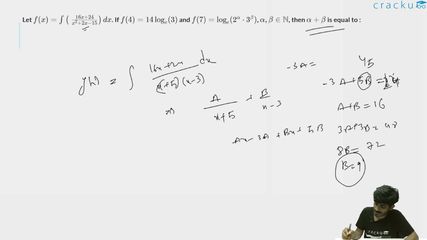
Let $$f(x) = \int \left( \frac{16x + 24}{x^2 + 2x - 15}\right) dx$$. If $$f(4) = 14\log_e(3)$$ and $$f(7) = \log_e(2^\alpha \cdot 3^\beta)$$, $$\alpha, \beta \in \mathbb{N}$$, then $$\alpha + \beta$$ is equal to :
First factorise the quadratic in the denominator:
$$x^{2}+2x-15=(x+5)(x-3)$$
Write the integrand in partial fractions: let
$$\frac{16x+24}{x^{2}+2x-15}=\frac{A}{x+5}+\frac{B}{x-3}$$
Then
$$16x+24=A(x-3)+B(x+5)=(A+B)x+(-3A+5B)$$
Equate coefficients:
$$A+B=16 \qquad -(3A)+5B=24$$
Solving, $$B=9$$ and $$A=16-9=7$$.
Thus
$$\frac{16x+24}{x^{2}+2x-15}=\frac{7}{x+5}+\frac{9}{x-3}$$
Integrate term by term:
$$f(x)=\int\frac{16x+24}{x^{2}+2x-15}\,dx=7\ln|x+5|+9\ln|x-3|+C$$
Use the given condition $$f(4)=14\ln 3$$ to find $$C$$.
At $$x=4$$, $$x+5=9,\; x-3=1,$$ so
$$f(4)=7\ln 9+9\ln 1+C=7\ln 9+C$$
But $$\ln 9=\ln(3^{2})=2\ln 3,$$ hence $$7\ln 9=14\ln 3.$$
Since $$f(4)=14\ln 3$$, we obtain $$C=0.$$
Therefore
$$f(x)=7\ln|x+5|+9\ln|x-3|$$
Now evaluate $$f(7)$$.
At $$x=7$$, $$x+5=12,\; x-3=4,$$ so
$$f(7)=7\ln 12+9\ln 4$$
Express each logarithm using prime factors:
$$\ln 12=\ln(3\cdot 2^{2})=\ln 3+2\ln 2$$ $$\ln 4=\ln(2^{2})=2\ln 2$$
Hence
$$7\ln 12 =7(\ln 3+2\ln 2)=7\ln 3+14\ln 2$$ $$9\ln 4 =9(2\ln 2)=18\ln 2$$
Adding,
$$f(7)=7\ln 3+(14\ln 2+18\ln 2)=7\ln 3+32\ln 2$$
Combine into a single logarithm:
$$f(7)=\ln(3^{7})+\ln(2^{32})=\ln(2^{32}\cdot 3^{7})=\ln_e(2^{\alpha}\cdot 3^{\beta})$$
Thus $$\alpha=32,\; \beta=7 \;\Rightarrow\; \alpha+\beta=39$$
Option C which is: 39
Click on the Email ☝️ to Watch the Video Solution
Create a FREE account and get:
_1.webp)

Educational materials for JEE preparation

Ask our AI anything

AI can make mistakes. Please verify important information.
AI can make mistakes. Please verify important information.


