
Join Our JEE Preparation Group
Prep with like-minded aspirants; Get access to free daily tests and study material.
Sign in
Please select an account to continue using cracku.in
↓ →
Join Our JEE Preparation Group
Prep with like-minded aspirants; Get access to free daily tests and study material.
For the following circuit and given inputs $$A$$ and $$B$$, choose the correct option for output 'Y'
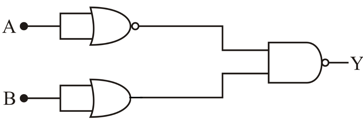
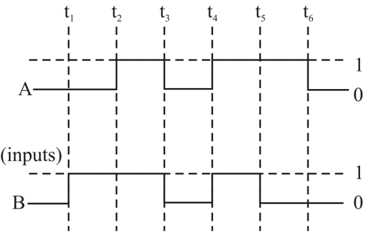
Let the two inputs be $$A$$ and $$B$$. All the four gates shown in the network are two-input NAND gates. We label the output of each NAND gate so that the algebra can be written step by step.
Gate-1 output: $$P = \overline{A\;B}$$ $$-(1)$$ Gate-2 output (driven by $$A$$ and $$P$$): $$Q = \overline{A\;P}$$ $$-(2)$$ Gate-3 output (driven by $$B$$ and $$P$$): $$R = \overline{B\;P}$$ $$-(3)$$ Gate-4 output (final output $$Y$$, driven by $$Q$$ and $$R$$): $$Y = \overline{Q\;R}$$ $$-(4)$$
Substitute $$P$$ from $$(1)$$ into $$(2)$$: $$Q = \overline{\,A \;\overline{A\;B}\,}$$
Apply the distributive property inside the complement: $$A \;\overline{A\;B} = A\;(\overline{A} + \overline{B})$$ (because $$\overline{X\,Y} = \overline{X} + \overline{Y}$$) Now, $$A\;(\overline{A} + \overline{B}) = A\;\overline{A} + A\;\overline{B} = 0 + A\;\overline{B} = A\;\overline{B}$$
Therefore, $$Q = \overline{A\;\overline{B}} = \overline{A}\;+\;B$$ $$-(5)$$ (using $$\overline{X\,Y} = \overline{X} + \overline{Y}$$ once more)
In the same way, substitute $$P$$ from $$(1)$$ into $$(3)$$: $$R = \overline{\,B \;\overline{A\;B}\,}$$ Proceeding exactly as before, we get $$R = \overline{B\;\overline{A}} = \overline{B}\;+\;A$$ $$-(6)$$
Finally, substitute $$(5)$$ and $$(6)$$ into $$(4)$$: $$Y = \overline{\,(\overline{A}+B)\;(\overline{B}+A)\,}$$
Expand the product: $$(\overline{A}+B)\;(\overline{B}+A) = \overline{A}\;\overline{B} + \overline{A}\;A + B\;\overline{B} + B\;A = \overline{A}\;\overline{B} + 0 + 0 + A\;B = \overline{A}\;\overline{B} + A\;B$$
Therefore, $$Y = \overline{\,\overline{A}\;\overline{B} + A\;B\,}$$
Recall De Morgan’s theorem, $$\overline{P + Q} = \overline{P}\;\overline{Q}$$. Apply it to the above expression:
$$Y = \overline{\overline{A}\;\overline{B}}\;\cdot\;\overline{A\;B} = (A + B)\;(\overline{A} + \overline{B})$$
Now expand once more:
$$(A + B)(\overline{A} + \overline{B}) = A\;\overline{A} + A\;\overline{B} + B\;\overline{A} + B\;\overline{B} = 0 + A\;\overline{B} + B\;\overline{A} + 0 = A\;\overline{B} + \overline{A}\;B$$
The Boolean expression $$Y = A\;\overline{B} + \overline{A}\;B$$ is the definition of the Exclusive-OR (XOR) operation between $$A$$ and $$B$$, symbolically $$A \oplus B$$.
Hence the network implements an XOR gate, so the truth table of $$Y$$ is
A B | Y
0 0 | 0
0 1 | 1
1 0 | 1
1 1 | 0
Among the four answer choices, Option 3 corresponds to $$Y = A \oplus B$$. Therefore, Option 3 is correct.
Was this solution helpful?
Create a FREE account and get:
_1.webp)

Educational materials for JEE preparation

Ask our AI anything

AI can make mistakes. Please verify important information.
AI can make mistakes. Please verify important information.


