
Join Our JEE Preparation Group
Prep with like-minded aspirants; Get access to free daily tests and study material.
Sign in
Please select an account to continue using cracku.in
↓ →
Join Our JEE Preparation Group
Prep with like-minded aspirants; Get access to free daily tests and study material.
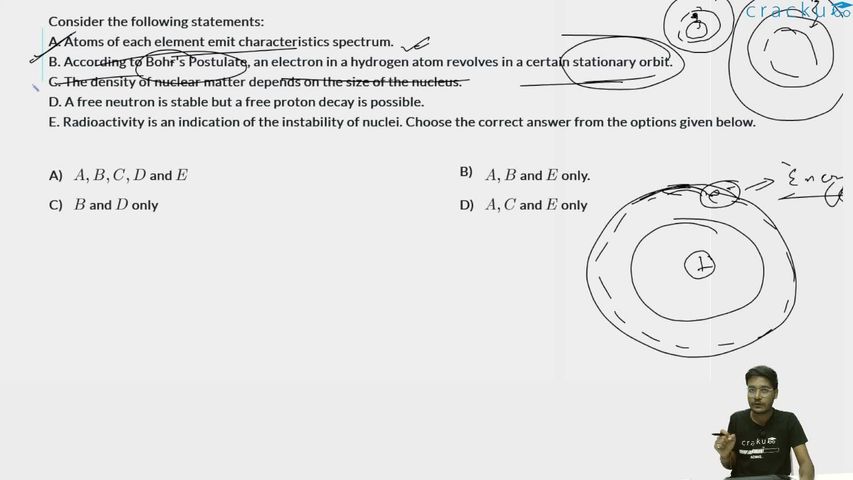
Consider the following statements:
A. Atoms of each element emit characteristics spectrum.
B. According to Bohr's Postulate, an electron in a hydrogen atom revolves in a certain stationary orbit.
C. The density of nuclear matter depends on the size of the nucleus.
D. A free neutron is stable but a free proton decay is possible.
E. Radioactivity is an indication of the instability of nuclei. Choose the correct answer from the options given below.
We begin by examining statement $$A$$. When an electron in an atom jumps from one allowed energy level to another, the atom emits or absorbs photons of energies $$\Delta E = h\nu$$. Since the set of energy levels is different for each element, the set of photon frequencies $$\nu$$ is also unique. Thus every element possesses its own characteristic line spectrum. Therefore, statement $$A$$ is true.
Next we look at statement $$B$$. Bohr’s first postulate states that an electron in a hydrogen atom can revolve only in those orbits for which the orbital angular momentum is quantised, viz. $$mvr = n\hbar$$ with $$n = 1,2,3,\dots$$. Such orbits are called stationary orbits because while the electron remains in one of them, it does not radiate energy. Hence, an electron indeed “revolves in a certain stationary orbit,” making statement $$B$$ true.
Now we test statement $$C$$ by recalling the empirical nuclear-radius formula $$R = R_0A^{1/3}$$, where $$R_0 \approx 1.2\times10^{-15}\ \text{m}$$ and $$A$$ is the mass number. The mass of the nucleus is approximately $$A m_n$$, where $$m_n$$ is the average nucleon mass. The volume is $$\dfrac{4}{3}\pi R^3 = \dfrac{4}{3}\pi R_0^3A$$. Hence the nuclear density is
$$\rho = \dfrac{A m_n}{\dfrac{4}{3}\pi R_0^3A} = \dfrac{3m_n}{4\pi R_0^3},$$
which is a constant independent of $$A$$. Because the density does not depend on the size of the nucleus, statement $$C$$ is false.
We turn to statement $$D$$. A free neutron undergoes beta decay according to $$n \rightarrow p + e^- + \bar{\nu}_e$$ with a mean lifetime of roughly $$880\ \text{s}$$, so it is unstable. Conversely, a free proton has never been observed to decay and is regarded as stable on experimental time-scales > $$10^{34}\ \text{years}$$. Therefore statement $$D$$, claiming the opposite, is false.
Finally, statement $$E$$ connects radioactivity to nuclear stability. Nuclei that spontaneously emit $$\alpha$$, $$\beta$$ or $$\gamma$$ radiation are doing so because they are in an energetically unstable configuration. Radioactivity is indeed a manifestation of nuclear instability. Thus statement $$E$$ is true.
Summarising: the true statements are $$A$$, $$B$$ and $$E$$, while $$C$$ and $$D$$ are false. The option that lists exactly $$A, B$$ and $$E$$ is Option $$B$$.
Hence, the correct answer is Option B.
Was this solution helpful?
Click on the Email ☝️ to Watch the Video Solution
Create a FREE account and get:
_1.webp)

Educational materials for JEE preparation

Ask our AI anything

AI can make mistakes. Please verify important information.
AI can make mistakes. Please verify important information.
