
Join Our JEE Preparation Group
Prep with like-minded aspirants; Get access to free daily tests and study material.
Sign in
Please select an account to continue using cracku.in
↓ →
Join Our JEE Preparation Group
Prep with like-minded aspirants; Get access to free daily tests and study material.
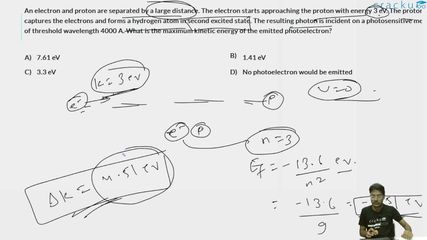
An electron and proton are separated by a large distance. The electron starts approaching the proton with energy 3 eV. The proton captures the electrons and forms a hydrogen atom in second excited state. The resulting photon is incident on a photosensitive metal of threshold wavelength 4000 A. What is the maximum kinetic energy of the emitted photoelectron?
We begin with an electron and a proton that are initially so far apart that the electrostatic potential energy between them is zero. The electron is supplied with kinetic energy $$3\ \text{eV}$$ and is allowed to approach the proton.
When the proton captures the electron, a hydrogen atom is formed. The question tells us that the atom is left in the “second excited state.” Counting from the ground state $$n=1$$, we have
Ground state : $$n=1$$ First excited state : $$n=2$$ Second excited state : $$n=3$$.
For a hydrogen atom, the stationary‐state energies are given by the well-known Bohr formula
$$E_n = -\dfrac{13.6\ \text{eV}}{n^2}.$$
Substituting $$n = 3$$ we obtain
$$E_3 = -\dfrac{13.6\ \text{eV}}{3^2} = -\dfrac{13.6\ \text{eV}}{9} = -1.511\ \text{eV}\;(\text{to three significant figures}).$$
The total mechanical energy before capture is purely the kinetic energy of the electron, because the potential energy at infinite separation is zero:
$$E_{\text{initial}} = +3.000\ \text{eV}.$$
The total mechanical energy after capture is the hydrogen-atom energy in level $$n=3$$:
$$E_{\text{final}} = -1.511\ \text{eV}.$$
By energy conservation, the excess energy must be emitted as a photon when the atom is formed. Thus,
$$E_{\text{photon}} = E_{\text{initial}} - E_{\text{final}} = 3.000\ \text{eV} - (-1.511\ \text{eV}) = 4.511\ \text{eV}.$$
This photon is next allowed to strike a photosensitive metal whose threshold wavelength is given as $$\lambda_0 = 4000\ \text{\AA}.$$ (Remember $$1\ \text{\AA}=10^{-10}\ \text{m}$$.)
The work function $$\phi$$ of the metal is obtained from the photoelectric relation $$\phi = h c / \lambda_0$$. Using the convenient constant $$h c = 12400\ \text{eV\;{\AA}}$$, we calculate
$$\phi = \dfrac{12400\ \text{eV\;{\AA}}}{4000\ \text{\AA}} = 3.10\ \text{eV}.$$
Now we apply Einstein’s photoelectric equation
$$K_{\text{max}} = h\nu - \phi = E_{\text{photon}} - \phi.$$
Substituting the numbers just obtained, we get
$$K_{\text{max}} = 4.511\ \text{eV} - 3.10\ \text{eV} = 1.411\ \text{eV}.$$
Carrying the result to three significant figures, the maximum kinetic energy of the emitted photoelectron is therefore
$$K_{\text{max}} \approx 1.41\ \text{eV}.$$
Hence, the correct answer is Option B.
Was this solution helpful?
Click on the Email ☝️ to Watch the Video Solution
Create a FREE account and get:
_1.webp)

Educational materials for JEE preparation

Ask our AI anything

AI can make mistakes. Please verify important information.
AI can make mistakes. Please verify important information.
