
Join Our JEE Preparation Group
Prep with like-minded aspirants; Get access to free daily tests and study material.
Sign in
Please select an account to continue using cracku.in
↓ →
Join Our JEE Preparation Group
Prep with like-minded aspirants; Get access to free daily tests and study material.
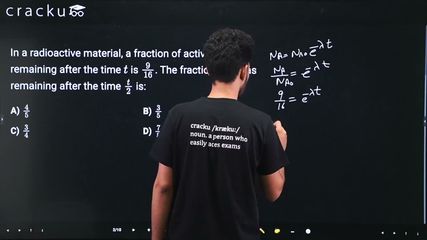
In a radioactive material, a fraction of active material remaining after the time $$t$$ is $$\frac{9}{16}$$. The fraction that was remaining after the time $$\frac{t}{2}$$ is:
We know the radioactive-decay law: the number of undecayed nuclei at time $$t$$ is $$N(t)=N_0\,e^{-\lambda t}$$, where $$N_0$$ is the initial number of nuclei and $$\lambda$$ is the decay constant.
The fraction of active material remaining at any time is therefore
$$\text{fraction}=\frac{N(t)}{N_0}=e^{-\lambda t}.$$
According to the question, after the time $$t$$ the fraction left is $$\dfrac{9}{16}$$, so
$$e^{-\lambda t}=\frac{9}{16}. \quad -(1)$$
Now we want the fraction that remains after half this time, that is at $$\dfrac{t}{2}$$. Using the same decay law, at time $$\dfrac{t}{2}$$ the fraction becomes
$$\frac{N\!\left(\dfrac{t}{2}\right)}{N_0}=e^{-\lambda\left(\dfrac{t}{2}\right)}=e^{-\frac{\lambda t}{2}}.$$
To connect this with equation (1), observe that
$$e^{-\frac{\lambda t}{2}}=\left(e^{-\lambda t}\right)^{\!1/2}.$$
Substituting the value of $$e^{-\lambda t}$$ from equation (1), we get
$$e^{-\frac{\lambda t}{2}}=\left(\frac{9}{16}\right)^{\!1/2}.$$
Taking the square root of $$\dfrac{9}{16}$$ step by step:
$$\left(\frac{9}{16}\right)^{\!1/2}=\frac{\sqrt{9}}{\sqrt{16}}=\frac{3}{4}.$$
Thus, the fraction of active material remaining after the time $$\dfrac{t}{2}$$ is $$\dfrac{3}{4}$$.
Hence, the correct answer is Option C.
Was this solution helpful?
Click on the Email ☝️ to Watch the Video Solution
Create a FREE account and get:
_1.webp)

Educational materials for JEE preparation

Ask our AI anything

AI can make mistakes. Please verify important information.
AI can make mistakes. Please verify important information.
